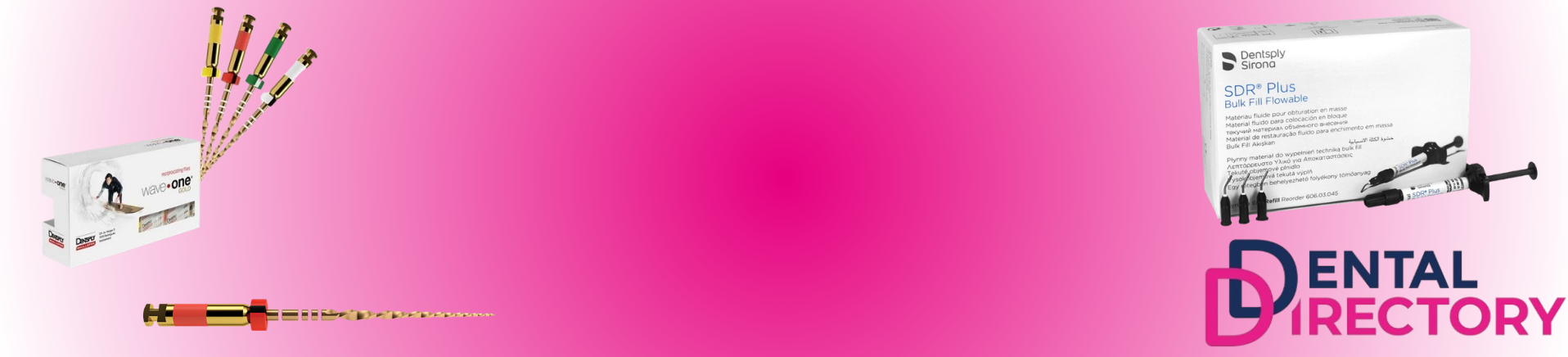
It’s already been a decade since Dentsply Sirona’s first reciprocating motion files hit the market, and fifteen years since the SDR® brand made waves as a revolutionary new bulk fill range. Even now, it’s fair to say that both SDR® and WaveOne® Gold remain fundamental parts of modern root canal therapy. Used in more than 130 countries and, according to Dentsply Sirona’s record data, more than thirty-five million procedures per year, it seems like neither product is showing any sign of being left behind. So, as part of both product range's anniversary celebrations, we’re going to be looking at what makes the WaveOne® Gold reciprocating file system, and SDR® Bulk Fill materials so impactful.
WaveOne® Gold - All About Reciprocating Motion
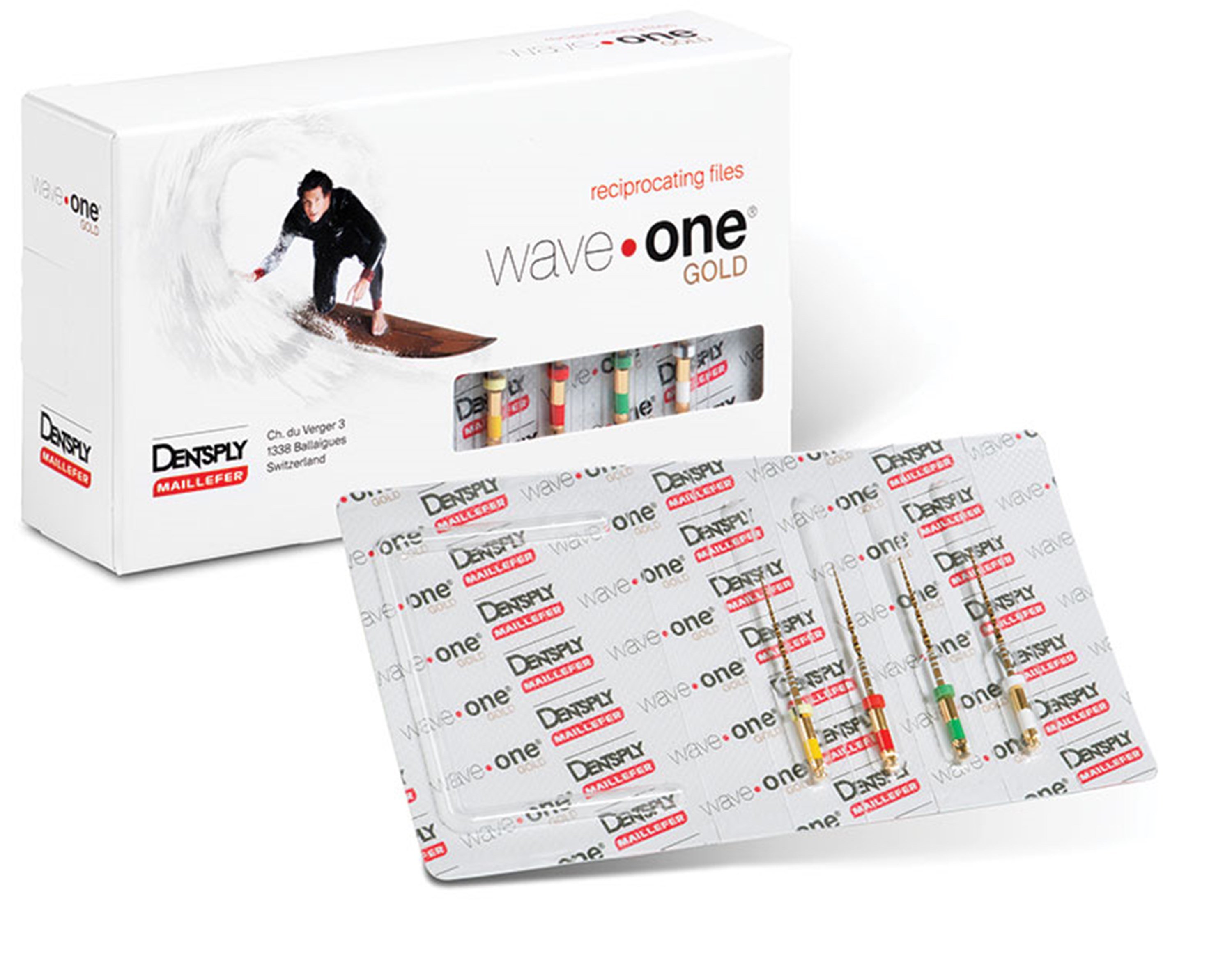
To consider what makes the WaveOne® Gold system successful, we should first consider the basics, such as how they are used, which is why it’s worth mentioning that WaveOne® Gold files are reciprocating. This means that they are turned one way (counterclockwise) to engage or cut. Then they are turned back, clockwise so that the file can disengage and be turned to cut again with another counterclockwise motion. After three of these back-and-forth motions, a full circle will have been made, allowing for a controlled and efficient obturation. Further to the topic of clinician control, WaveOne Gold files have a parallelogram cross-section shape, which helps to reduce the risk of a “screwing” effect and decrease the margin of error.
The benefits of such a file system are numerous. Firstly, reciprocating systems are very efficient at debris removal. According to a study by De-Deus, G., et al. (1) reciprocal file systems demonstrate an improved control over apically extruded debris. Secondly, these files are excellent for progressing to the apex without applying too much force. Thirdly, they demonstrate a reduction of torsional stress, and reduced risks of file separation. All of this to say, WaveOne Gold files empower dentists to perform a safer, simpler preparation of the root canal.
WaveOne® Gold - Conform Fit Technology for Warm or Cold Obturation
Another benefit of the WaveOne® Gold system is that it can be used either with warm or cold Obturation techniques when used with Conform Fit gutta-percha.
For cold techniques, accuracy is important. Which is why each shaping instrument has its own Conform Fit gutta-percha, and thanks to its injection-molded design, these are 40% more accurate than traditional hand-rolled gutta-percha. These molds are designed to mimic the shaping instrument and are adapted to the variable taper of each instrument.
For warm obturation techniques, the gutta-percha from Conform Fit has an improved melt flow, which helps to improve coverage, and adaptation to the canal wall. See below for a diagram which shows how using Conform Fit can improve the range of fit for your warm obturation techniques.
WaveOne® Gold - A Gold Standard File System
The golden metallic coating of each of these files isn’t just for show; it actually helps to make a tougher, more effective instrument. According to Dentsply Sirona's testing, the gold metallurgy of WaveOne® Gold provides the file with a 50% improvement in cyclical fatigue resistance when compared to other WaveOne files (2). This helps to keep your file sharp and working at optimal conditions throughout the obturation process.
Celebrating 15 years of Dentsply Sirona's SDR Bulk Fill composite range
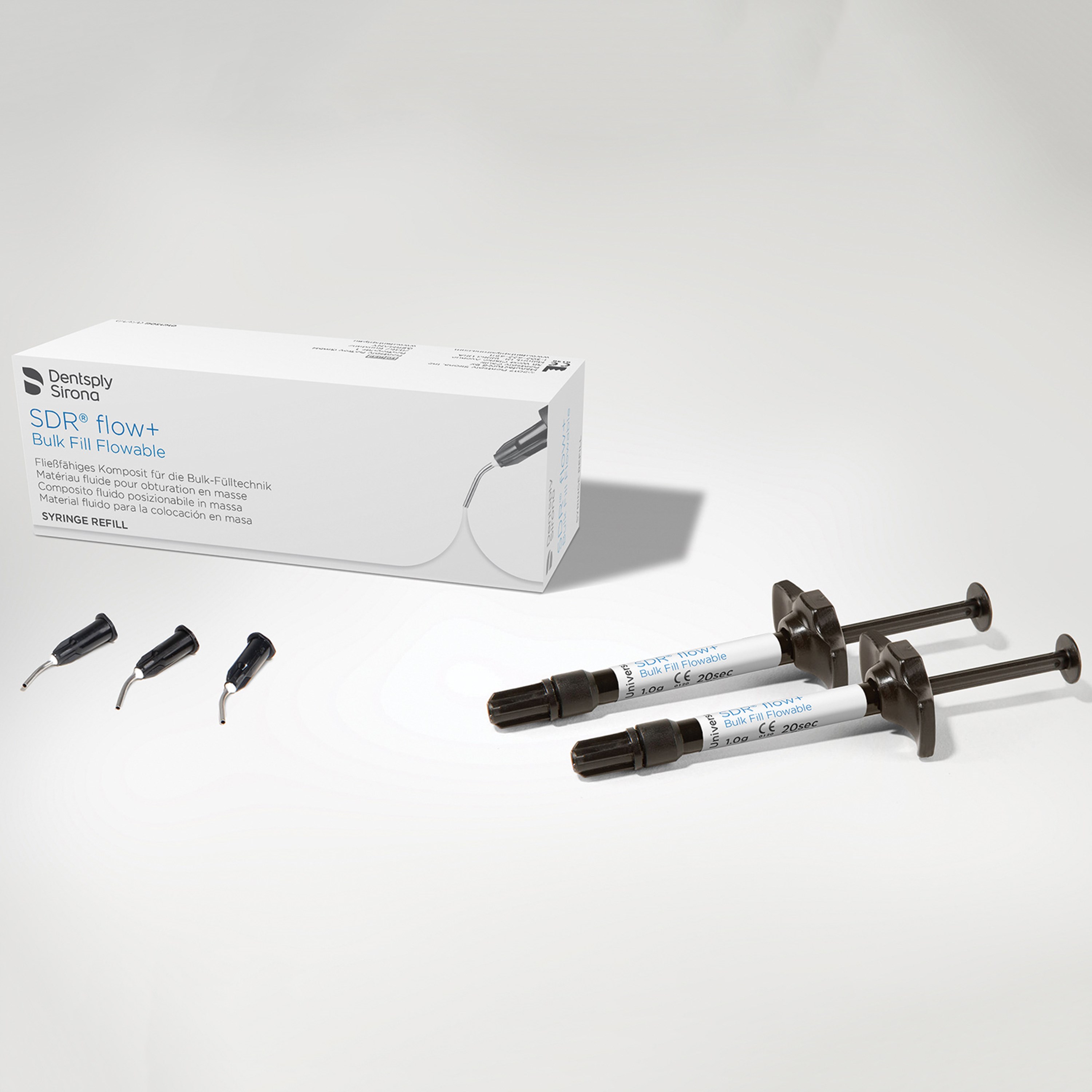
For class I and II restorations, Dentsply Sirona SDR® has been a standout bulk fill composite range. First released to market in 2009, SDR® Bulk Fill materials have since been used in an estimated 35 million applications and has been evaluated in several key studies, but the SDR brand’s success can be broken down into two key categories, its adaptation and its efficiency.
Adaptation
Adaptation is a key focus of any bulk fill composite, because even marginal gaps can lead to the creation of wall lesions and even result in the development of secondary caries (3). To prevent this, SDR® was created with a uniquely high level of flowability, so that it can get into the microcracks, nooks, and crannies during a root canal to minimise gaps.
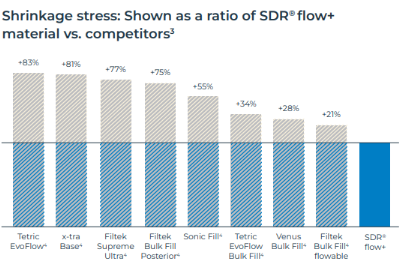
Application isn’t the only time gaps can form; bulk fill composites can shrink and lead to marginal gap formation (4). However, because SDR® materials utilise resin monomers to form a polymer matrix, it manages to maintain a low level of shrinkage stress, leading to longer-lasting restorations. See the diagram below for more:
Efficiency
Regarding efficiency, SDR® bulk fill was the first composite to allow for 4mm bulk placement in flowable consistency without any additional liner. This improved efficiency by decreasing the time spent on placement by an estimated 40% when compared to a classic layering technique. On top of saving dentists time, it also saved them a fair amount of money with their inventory management. Since liner was no longer necessary for restorations, it no longer needed to be purchased or managed in inventory. The cherry on top is that SDR® bulk fill materials also self-level, requiring no additional manipulation. Not many other bulk fills at the time could demonstrate this kind of convenience, and it helped to shave time off of lengthy restorations.
It should be noted that the newest product in the SDR® Bulk Flow range, SDR® flow+, comes in four shades, A1, A2, A3, and Universal. Each of these shades has been made to suit a wide range of visible restorations. This means that esthetic, toothlike outcomes don’t need to come second to application efficiency and adaptation.
Conclusion
The WaveOne® Gold file system and SDR® bulk fill materials both demonstrate a level of innovation which has given both ranges staying power and mass appeal across decades. Both ranges display Dentsply Sirona’s dedication towards overcoming the challenges which face dentists and empowering them to reach new levels of effectiveness and efficiency.
Shop the WaveOne® Gold file system with Dental Directory.
Shop SDR Bulk Flow with Dental Directory
Footnotes
(1) De-Deus, G., et al., apically extruded dentin debris by reciprocating single-file and multi-file rotary system. Clinical Oral Investigations, 2015. 19(2): p. 357-361
(2) Dentsply Sirona Internal Data: 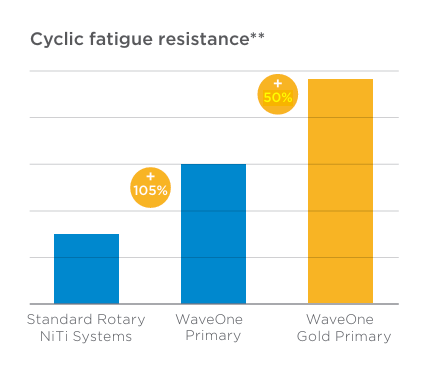
(3) Kuper NK, Opdam NJ, Ruben JL, de Soet JJ, Cenci MS, Bronkhorst EM, et al. Gap size and wall lesion development next to composite. J Dent Res 2014;93, 108S–13S
(4) Nedeljkovic et al. Is secondary caries with composites a material-based problem? Dent Mater 31 (2 0 1 5), e247–e277 3