Keeping patients safe can mean lots of different things. From dealing with the threats to a patient’s wellbeing that you can see, such as cavities, calculus and bleeds, to the threats that you can’t see, such as cross contamination.
Infection prevention and control are two of the most important components of patient safety and satisfaction – no patient is going to remember if you gave them a perfect restoration if they ended up getting an infection shortly after. This is further reflected in current UK legislation and guidance, HTM 01-05 6.57 states that ‘the use of disinfectant or detergent will reduce contamination on surfaces’. It’s not just patients, every time you clean a surface in your dental practice, you’re making it safer for yourself and your staff too.
So, to help stay on top of contaminants in your practice we’ve written this quick guide of the top infection control brands, products, and things you need to know.
If you don’t know, we’re Dental Directory, we’re a dentistry supplier who’ve been happily supporting practices for the last fifty years. We do training, equipment, product offers, and even full surgery kit fit-outs. Once you’re done with this blog, why not see what we can do for you?
Basic Cleaning and Disinfection – The difference between Detergent and Disinfectant.
We’re starting with a very basic explanation. Even if you’re aware of the distinction between Detergent and Disinfectant it’s helpful to remind yourself on their differences, because they aren’t the same, even if some surface cleaners do combine the two.
Cleaning involves the removal of soil. Now, we know how this sounds but don’t be fooled by the term ‘soil’, we’re not just referring to dirt, the term soil includes other contaminants such as pus or blood. To remove soil from a surface effectively a detergent is required. Detergents utilise surfactants to remove soil from a surface, whereas disinfection is about killing or inactivating microorganisms using chemicals with proven antimicrobial activity.
Without the use of detergents to remove soil, and disinfectants to kill any remaining contaminants, you won’t be able to achieve the level of cleanliness required to prevent infection.
Detergents -
- Remove soils from a surface.
- Include surfactants, which break down the surface tension which allows for soil to cling to a surface.
- Are used in general cleaning.
- A cornerstone of infection control. Must be used alongside disinfectants to prevent cross-contamination.
Disinfectants -
- Destroy or inactivate bacteria, fungi, or infectious pathogens.
- Include powerful active ingredients such as alcohol or chlorine.
- Are used on non-organic or non-living surfaces.
- Are also a cornerstone of infection control. Must be used alongside detergents to prevent cross-contamination.
FAQ – What are antiseptics?
Antiseptics are somewhat similar to disinfectants in that they destroy harmful and infectious microbes, except antiseptics have been made to be used on organic surfaces, such as human skin. Antiseptics often utilise powerful chemical compounds like Chlorhexidine.
Basic Cleaning and Disinfection – Surfaces, Equipment, and Sterility.
In the dental practice, there are around four distinct areas which require different types of disinfection and cleaning. There are instruments, equipment, surfaces, and clinical surfaces. Instruments include any tools that you might use in dentistry, such as scalers or hand mirrors. Equipment is a broad category and can include handheld equipment such as handpieces, or larger pieces of equipment such as suction pumps. Obviously, each piece of equipment will have different protocols for exterior and interior cleaning.
Example cleaning protocol for suction pump exterior -
- - Switch power supply off before cleaning the main unit.
- - Equip necessary protective equipment such as gloves to avoid contamination.
- - Wipe surfaces down with a mild disinfectant solution and clean damp cloth. Taking care to follow manufacturer instructions regarding which sections can be cleaned this way.
Example cleaning protocol for suction pump interior -
- At the start of the day, flush your suction pump's lines with a high-level disinfectant (such as Orotol) for two minutes, then rinse those lines for at least two more minutes with clean running water.
- Between patients, this suction pump should be flushed with water for half a minute, and use disinfectant on the cannulas for at least two minutes.
- At close of business, flush your suction pump with your disinfecatnt of choice. If possible you should leave this disinfectant to act overnight.
- Flush and clean every instrument with water.
- Clean your spittoon outlet and suction system filter.
Surfaces and clinical surfaces have been listed separately because not every surface in the dental practice deals with the same level of regular contamination. For example, your reception desk should have little-to-no instances where it has to withstand blood spray or pus for example. By comparison, the surface of your dental chair may have to deal with either.
Please note - Instruments must be sterilised between use. Disinfection is different to sterilisation. Please see 'sterilisation and its place in the dental practice' for more.
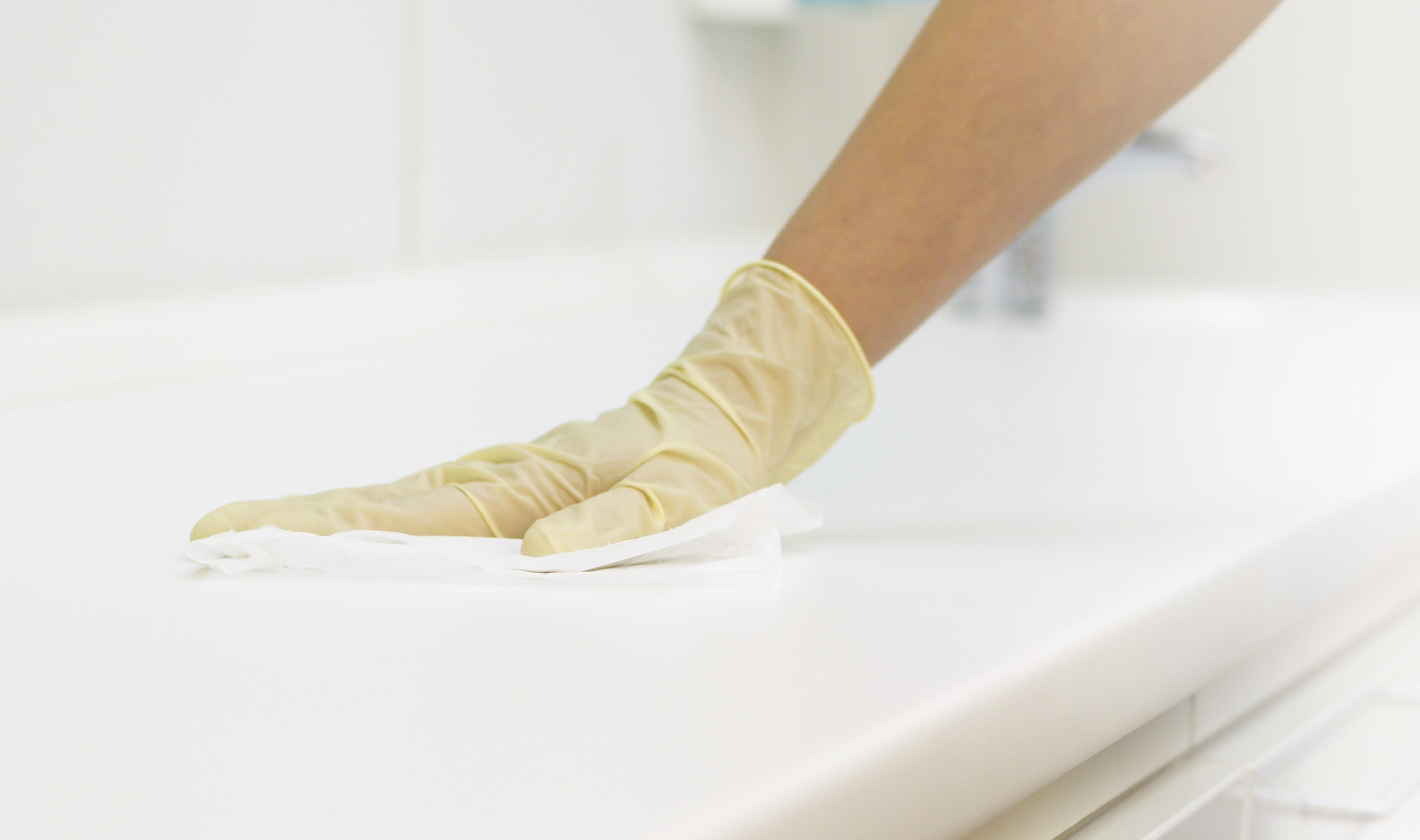
Example cleaning protocol for non-clinical surfaces - Surfaces are to be cleaned using a detergent, water, and cloth. Soils are to be removed. If the circumstances require disinfection to follow, then utilise disinfectant wipes or sprays.
Example protocol for clinical surfaces - Surfaces are to be cleaned using a detergent, water, and cloth. Soils are to be removed. Following this, select the appropriate disinfectant for use on its respective surface.
Disinfect the surface, paying particular attention to the required contact time and direction of cleaning.
National Colour Coding Scheme.
If you're wondering how to use general-use items such as buckets or sponges, there is a national colour coding scheme in place for floor and general surface cleaning across the dental practice. The scheme is as follows:
- Red - wash-rooms/bathrooms.
- Blue - Offices and general areas.
- Green - Kitchens
- Yellow - Clinical and decontamination areas.
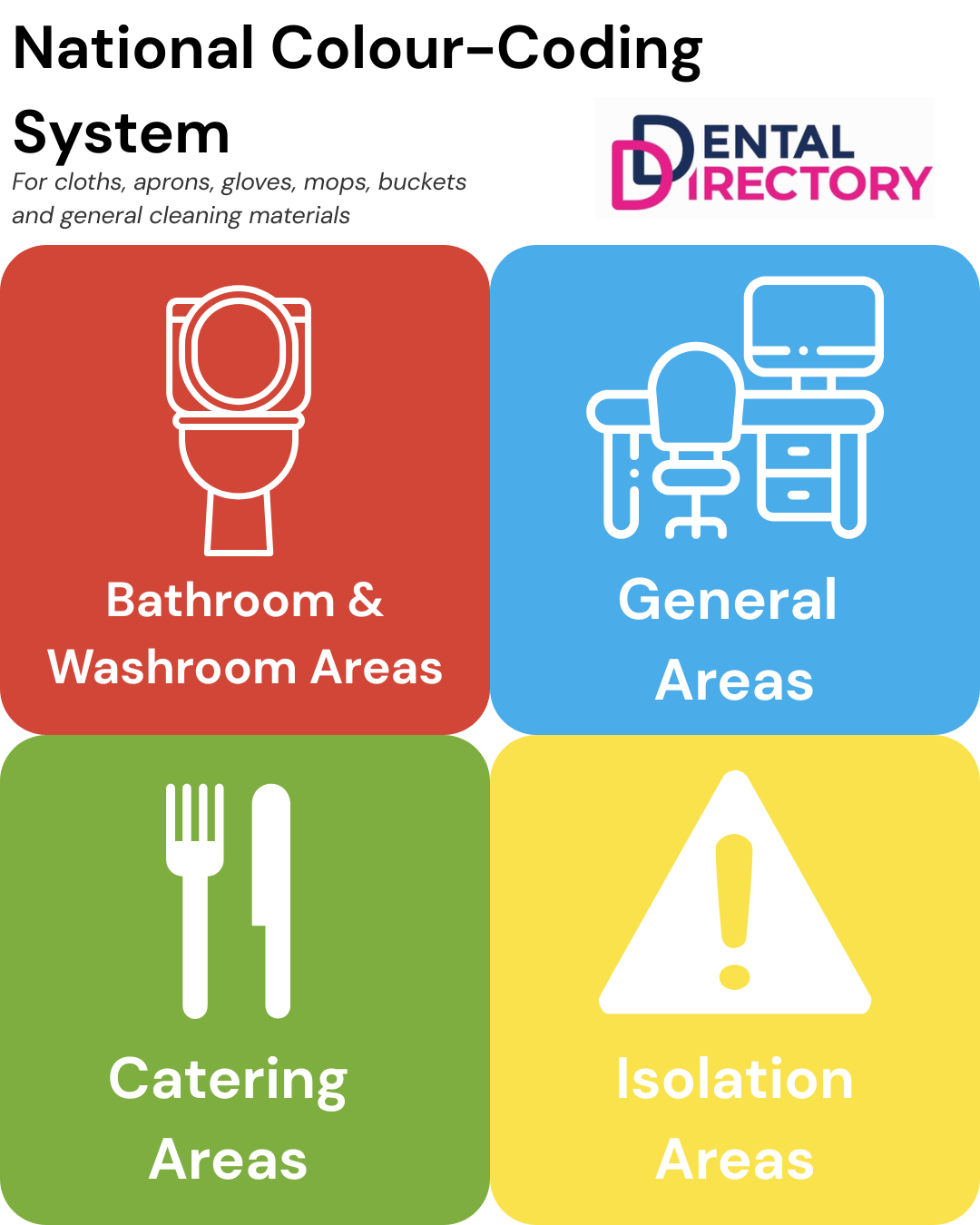
Direction of cleaning – Cleaning can cause recontamination if done improperly, try to clean from top to bottom, and clean to dirty in most cases. In the instance of dusting, ensure high horizontal surfaces are dusted before cleaning to avoid recontamination. To this end, we’d recommend cleaning floors last. Additionally consider appropriate signage for wet floors.
Types of Cleaning and Disinfection Products.
Cleaning and disinfection products come in a variety of shapes and sizes so as to best fit a specific task. Are you getting soils out from a dental chair? Wipes or sprays paired with a damp cloth are excellent at generating the friction required to remove stubborn deposits of any material, without damaging the surface underneath. Are you cleaning the complex interior of a system such as a suction pump? You’ll need a liquid for that.
Again, the considerations here are the form of what needs to be cleaned, whether it requires a detergent or disinfectant (or both) and the material compatibility of the cleaning device. But to broaden our scope to cover just the different types of cleaning products you’ll need in the dental practice, you’ll primarily be dealing with Surface Cleaners and Wipes. We've broken down the Surface Cleaner category into Liquids and Sprays to cover their two distinct delivery methods.
Sprays:
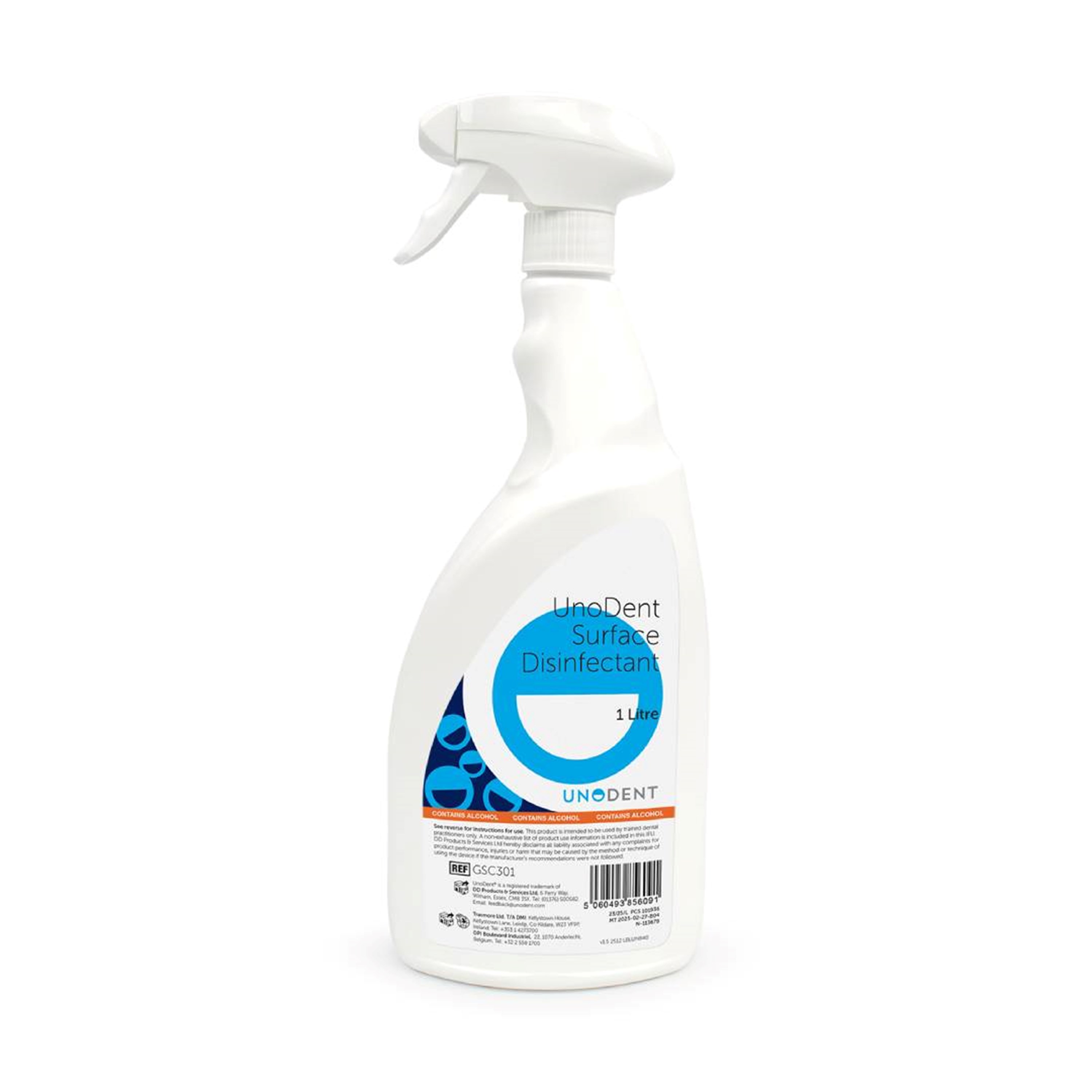
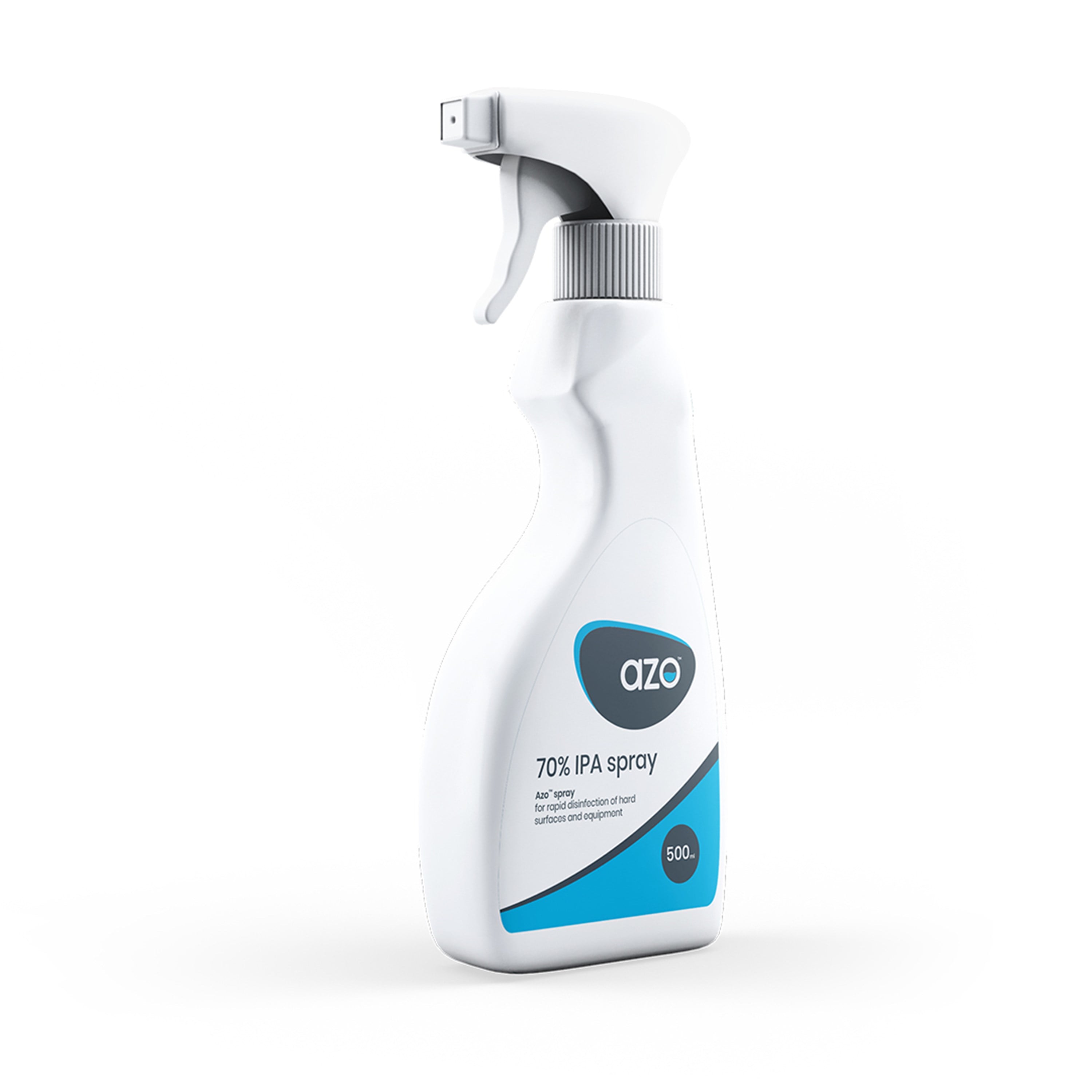 Fitted with a nozzle for dispensing dosed bursts of a cleaning solution across a large area, and designed to be easily carried around and stored, sprays are a very popular and convenient medium for dispensing cleaning or disinfectant liquid. These sprays can help to gently lubricate an area and saturate it with the solution, without causing pooling or damage. Shop Cleaning Sprays
Benefits of Spray application:
- ✓ Simple design - Trigger and nozzle system makes sprays easy to use, easy to control.
- ✓ Economical - Can cover a large surface area with just a few sprays.
- ✓ Refillable - Spray bottles can often be refilled with liquid cleaner.
Drawbacks of Spray application:
- ✗ Liquid - May leave streaks or residue
- ✗ Design Issues - Many nozzle designs can be clogged with improper use or repetitive use, impeding accuracy.
- ✗ Aerosolised Cleaner - May be less useful for precise cleaning.
Wipes:
Benefits of Wipes:
- ✓ Pre-packaged and ready to use - Very convenient to use in precise or large cleaning tasks.
- ✓ User-friendly - Easy to use, short contact times and convenient usage.
- ✓ Broad Range - Biodegradable, alcohol-free, and dry options available.
- ✓ Single-use - Wipes must be disposed of after usage to prevent cross-contamination.
Drawbacks of Wips:
- ✗ Powerful Chemicals- the powerful chemicals contained within each wipe may impact the environment.
- ✗ Storage requirements - Can dry out if not kept in an airtight environment.
- ✗ Landfill only - Must be disposed of after each use. Non-biodegradable wipe variants can be seen as wasteful.
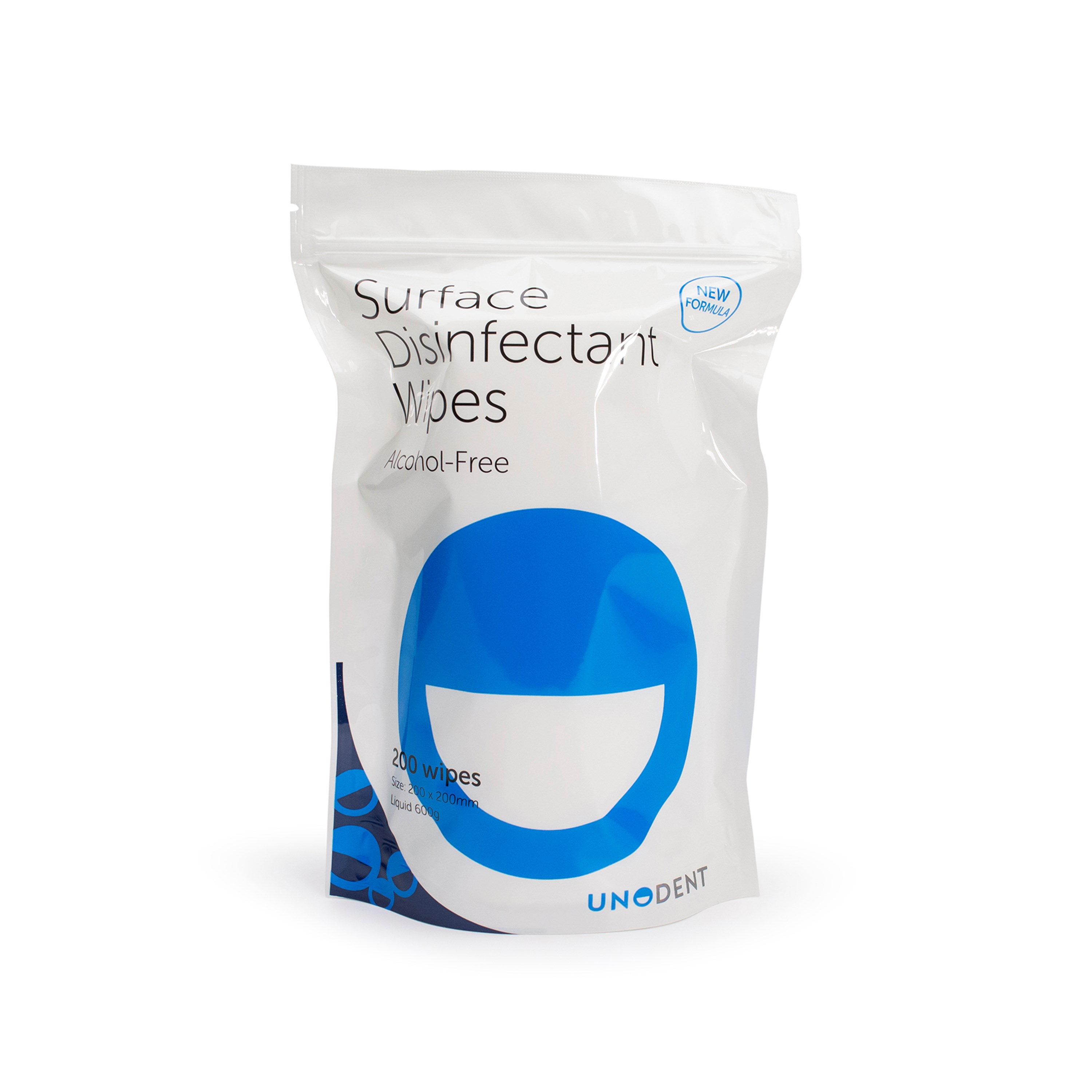
UNODENT
NEW Formulation Surface Disinfectant Wipes - Alcohol-free Refill Pack - Apple
CAW597 (Pack 200)
View Item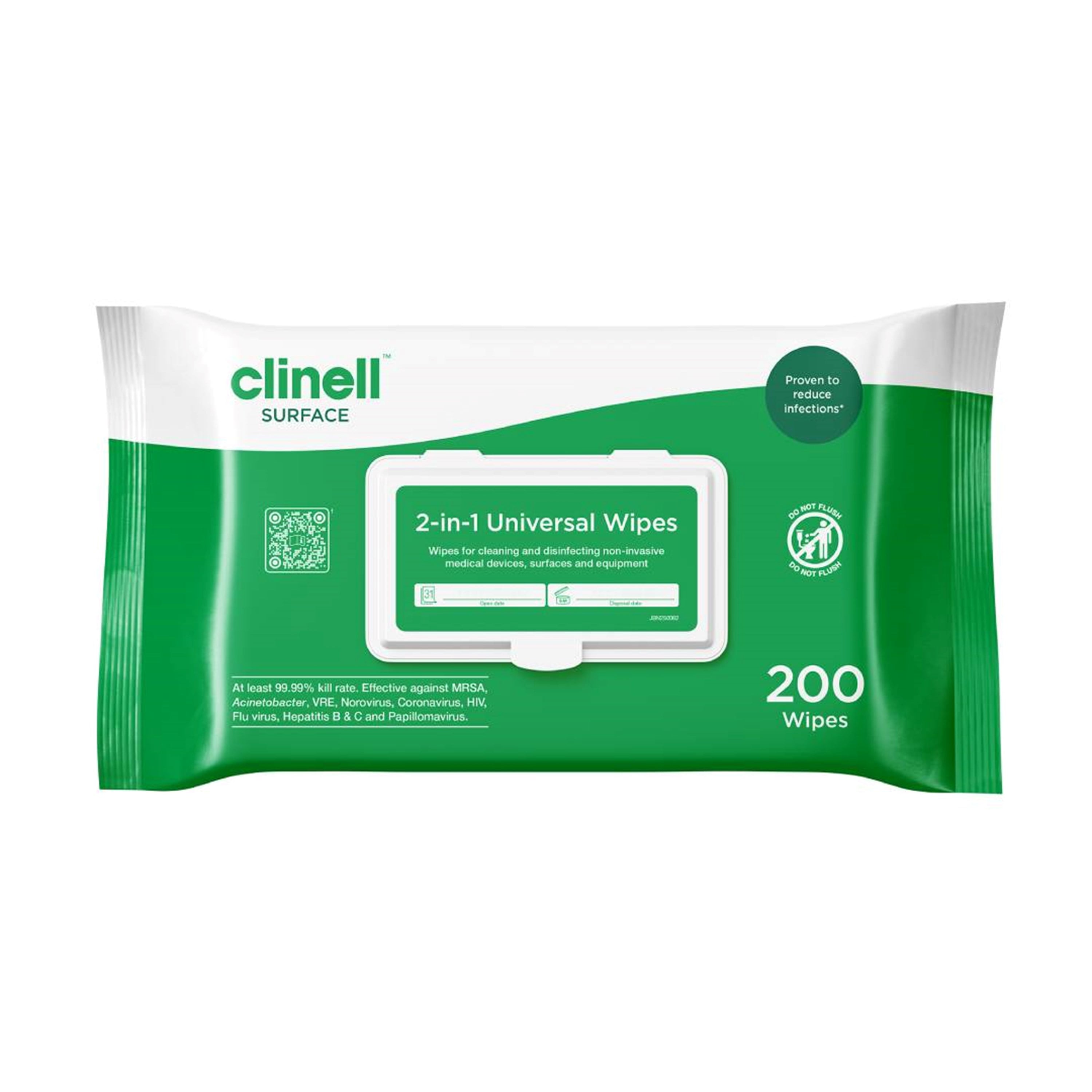
Liquid Disinfectants:
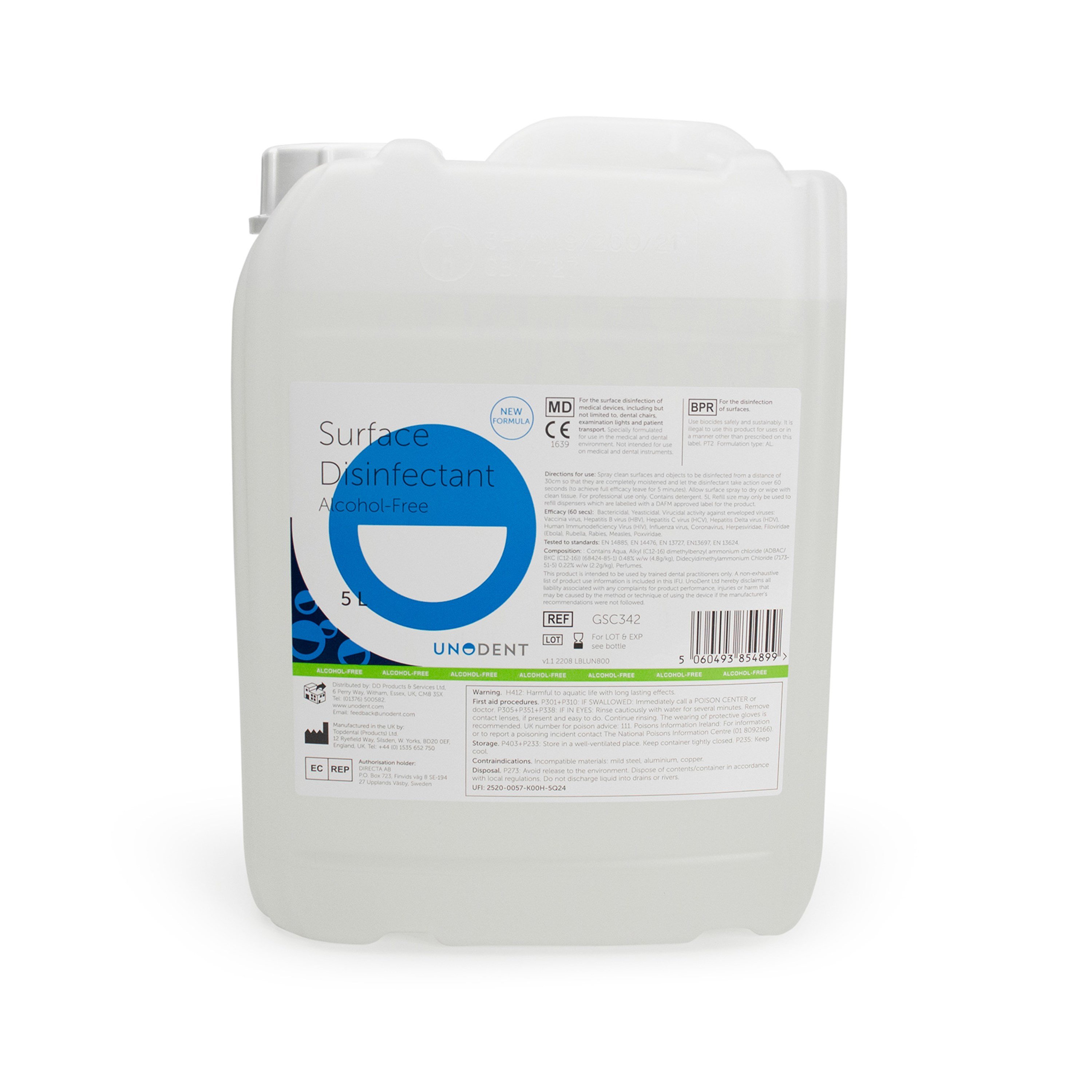
Also known as Surface Cleaners, this form of disinfectant is often purchased in bulk and either diluted before use and applied using a separate device (such as in the case of a mop). However in some instances there are cleaning liquids which are applied directly to dental instruments in a specific context, such as through ultrasonic baths, immersion baths, etc.
Shop Surface Cleaners
Benefits of Liquids:
- ✓ Soak-capable, Effective at disinfecting complex and precise internal mechanics.
- ✓ Versatile can be diluted, placed in spray bottles, or put on cleaning wipes.
- ✓ Fluid, Is the only cleaning product category which can be used in some contexts (I.e. immersion baths)
- ✓ Spreadable, Excellent for cleaning large, flat surfaces such as floors.
Drawbacks of Liquids:
- ✗ Spill, slip and trip hazard, can be spilled and can cause slips.
- ✗ Requires proper handling, Can cause damage if used improperly.
- ✗ Less convenient, requires preparation such as diluting, or other consumables like wipes.
Basic Cleaning and Disinfection – Roles and responsibilities.
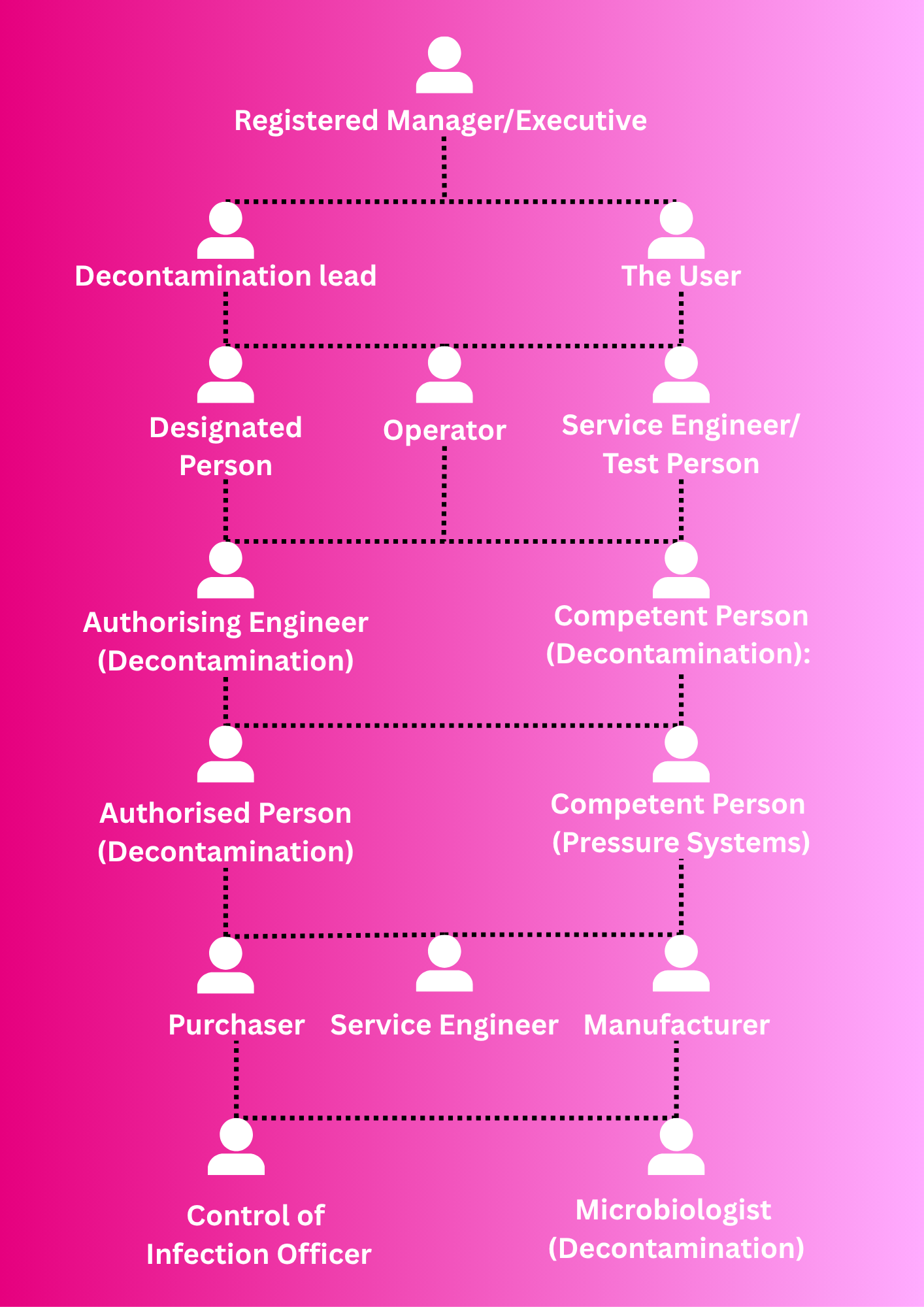
Disinfection and cleaning continuously is a big job, and more than just any one member of the dental practice can handle. For this reason the tasks required to stay on top of infection are typically delegated across a team of dental practitioners. The HTM: 01-05 document lays out the following roles, we’ve summarised their descriptions for the sake of brevity and clarity, but we’d recommend you check out the document as well:
PLEASE NOTE – As stated by HTM: 01-05, one person may fill two or more of these roles. You do not need a member of staff to fill each role separately.
1 - Registered Manager/Executive Management: Holding the ultimate responsibility for decontamination equipment ownership, as well as the definition and appointment of the staff in decontamination. In a dental practice, this may be an NHS contractor, practice owner, or a person of similar authority.
2 - Decontamination lead: This is the responsible person for ensuring overall decontamination procedures are adequate and followed within a practice. The decontamination lead will report to the general manager.
3 - The User: The User is someone who takes responsibility for the daily enaction of decontamination processes, and the functioning of decontamination equipment. The User also trains operators on how to follow decontamination processes. This role has some crossover with decontamination lead.
4 - Operator: This is someone who uses the equipment on a daily basis and will follow procedures laid out by the user and the decontamination lead.
5 - Service Engineer/Test Person: This is a member of personnel who is responsible for testing the machines being used for appropriate functionality, and validations.
6 - Designated Person: This is a member of personnel who connects the practice and support services supplied externally. This can be external service, maintenance and testing services.
7 - Authorising Engineer (Decontamination): An external role. The Authorising engineer for decontamination provides guidance and advice on compliance as it relates to decontamination. This includes he implementation of HTM 01-05 and any associated guidance documentation. You can find a list of suitable persons at the voluntary register held by the Institute of Healthcare Engineering and Estate Management (IHEEM) (http://www.iheem.org.uk/ Technical-Platforms).
8 - Authorised Person (Decontamination): this Authorised Person provides technical support to the Competent Person and liaises with the Authorising Engineer.
9 - Competent Person (Decontamination): Responsible for the servicing, testing and maintaining of the decontamination equipment within the practice. This role can be someone in direct employment from the practice, or sourced from a third party.
10 - Competent Person (Pressure Systems): Each practice is legally responsible for the safety of its decontamination equipment. This is particularly important for sterilizers that are pressure vessels. The need for insurance and a Written Scheme of Examination is a legal liability. This is likely to be provided by an insurance company.
11 - Service Engineer: This is an engineer who has been provided under a service level agreement or contract. A service engineer needs to be certified by the service agent or equipment manufacturer to be competent to both service and test specified decontamination equipment. The engineer’s roles include performing validation tests, sharing information to an Authorising Engineer or Authorised person, and giving opinions on the outcomes of validation testing.
12 - Manufacturer: the manufacturer, supplier or agent of any decontamination equipment
13 - Purchaser: the purchaser of any decontamination equipment – likely to be the practice. In addition to these roles the practice may require specialist clinical advice and guidance, so the purchases should be able to source a Control of Infection Officer and Microbiologist, either within the practice or externally.
14 - Control of Infection Officer: A person who provides advice regarding infection prevention and control and the ability to audit and implement relevant advice.
15 - Microbiologist (Decontamination): This role may be required for certain procedures and practices, and a microbiologist should be sought when a practice is in doubt. Access to a Microbiologist can be made via institutions that employ such professionals. This would include acute trusts, pathology departments and Public Health England laboratories.
Example Organogram:
How to Best Manage Staff and Staff Roles in Decontamination
With a multitude of roles required to remain compliant, keeping each member of staff’s role managed effectively may feel overwhelming. However, if you follow the guidance laid out by HTM 01-05, there are certain basics which can help to make this process easier.
Firstly, every member of decontamination needs to be aware of and trained in their role. Additionally, decontamination staff should be aware of each other’s responsibilities, where their role ends and what falls within their professional remit.
When appropriate, each practice can establish its own system concerning staff responsibilities, which can help to alleviate pressure on some smaller practices, but be warned, these practices will be expected to demonstrate the same degree of understanding, competency and management as required by Choice Framework for local Policy and Procedures 01-01 Part A.
A Quick Guide - Local Policy and Procedures 01-01 Part A.
Given limitations to space and staff, smaller practices may be unable to appoint all responsible posts and a local decision regarding them will need to be made, however the practice must be able to demonstrate the following:
- An understanding of legal liabilities& the current best practices.
- The obtaining of professional advice in equipment purchase, maintenance, testing and operation (where necessary).
- Evidence regarding the performance of all relevant maintenance and testing duties.
- Compliance with the Pressure Systems Safety Regulations 2000
Cleaning and Disinfection Brands
Schülke -
Experts in infection prevention, and an established company of over 130 years, Schülke is responsible for some of the best-known brands in disinfection. We won’t be going over their full catalogue, just exclusively the Mikrozid and Gigasept ranges. We'd thoroughly recommend you check out other Schülke cleaning products, but we can't cover them all in just one article!
Mikrozid
The Mikrozid® range offers products for all areas of the practice in a variety of formats including wipes, sprays and liquids. Alcohol based, low alcohol and alcohol-free formulations are all available to meet the specific cleaning and disinfection requirements of all surfaces.
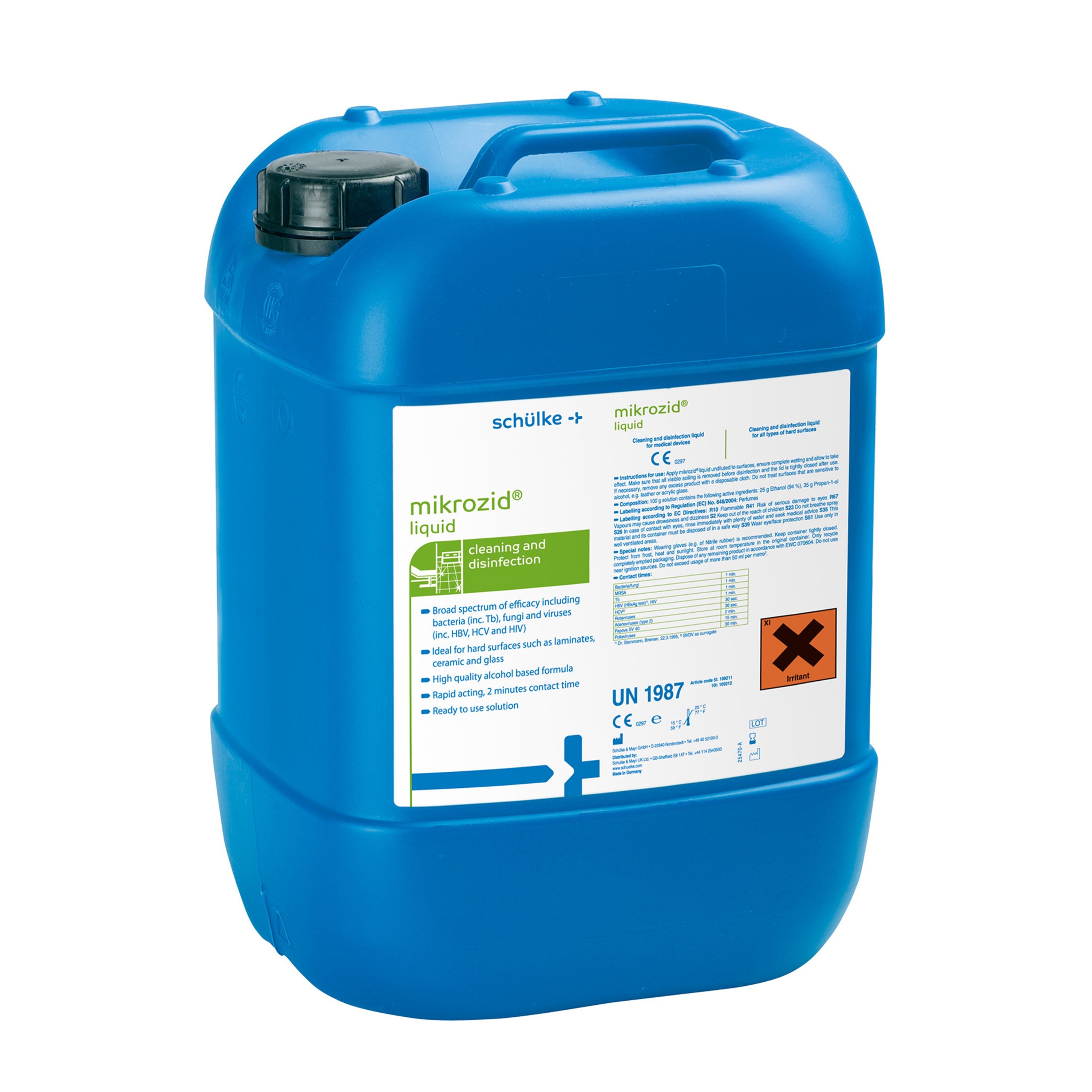
Mikrozid® liquid
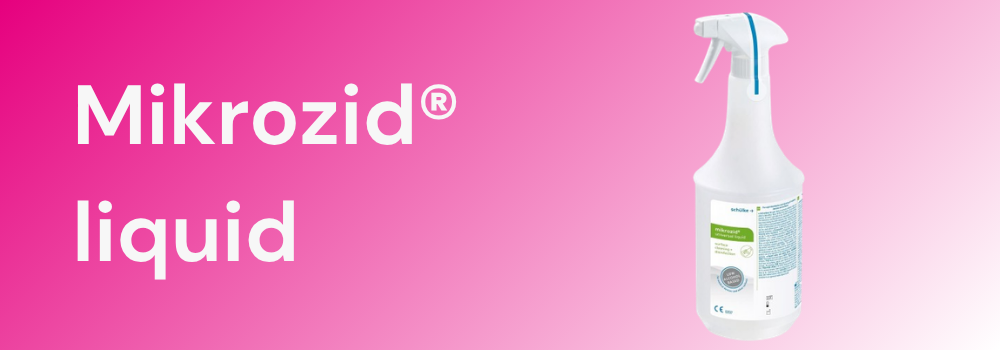
Mikrozid® liquid provides effective cleaning and disinfection in a single ready to use product. Effective against bacteria (including TB), yeast and viruses (including HBV, HCV and Rotavirus) Mikrozid liquid is also rapid acting, with added surfactants for additional cleaning performance.
Mikrozid® liquid is the first choice for best practice cleaning and disinfection of clinical areas. It has been independently proven that alcohol with an added surfactant is the best option for cleaning and disinfecting high risk and clinical areas; and used correctly alcohol doesn’t bind protein to surfaces. The alcohol ensures accelerated drying times making it ideal for busy practices.
Mikrozid® liquid Benefits
- Created using two alcohols for a very high performance against viruses within one minute contact time.
- Cleaning and disinfection action effective against yeast and viruses, including enveloped viruses/
- Rapid-drying action, no residue.
Mikrozid® alcohol-free liquid
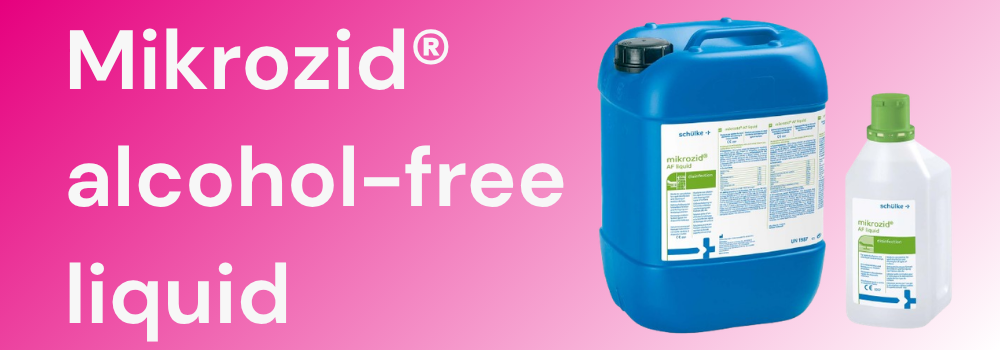
Alcohol-free Mikrozid® universal liquid offers dual cleaning and disinfection of surfaces in a single product. It is effective against bacteria including TB, as well as viruses like norovirus. Mikrozid® universal contains added surfactants to boost cleaning performance and is fast acting with excellent material compatibility. It can be used to clean touch screens, keyboards and sensitive equipment, as well as dental chairs and surfaces or dental practice items where prolonged exposure to moisture would cause damage.
Mikrozid® alcohol free liquid is specifically designed to clean and disinfect all alcohol sensitive materials including leather, PVC, glass and Perspex. With added surfactants, Mikrozid® alcohol free liquid has enhanced cleaning properties as well as being an effective disinfectant.
Alcohol-Free Mikrozid Universal Liquid Brochure
Alcohol-Free Mikrozid® Universal Liquid Benefits
- No- alcohol formulation improves material compatibility, particularly useful on dental chairs.
- Formulated with added surfactants for enhanced cleaning performance disinfection.
- High efficacy against bacteria, yeast and enveloped viruses.
- One-minute contact time, great for busy practices.
- Convenient ready-to-use solution.
Gigasept
Unlike Mikrozid, which is a cleaning range which has products you’d use across the dental practice, Gigasept is specifically a disinfectant and cleaner for medical instruments. Coming in many variations such as gigazyme or gigasept pearls, this range is suitable for a broad swathe of different cleaning tasks, and for use with different products, but ultimately it is for use with ultrasonic baths or immersion baths.
“The optimal combination of potent enzymes (protease = splits proteins; lipase = breaks down contaminants containing fats; amylase = removes polysaccharides) and an innovative surfactant system ensures outstanding cleaning of thermostable and thermolabile instruments of all kinds while providing excellent material compatibility.”
Gigasept Products -
Rotasept
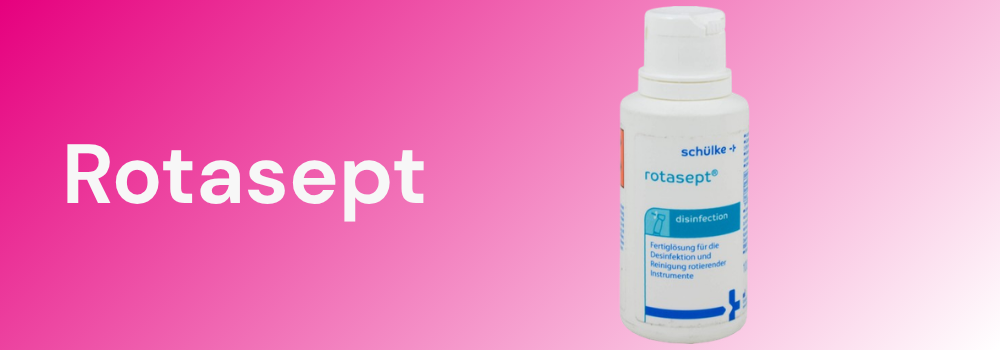
A specialist cleaning liquid designed for manual cleaning and disinfection of burs, and all rotating precision instruments. Rotasept demonstrates high levels of efficacy and strong material compatibility, which helps to prevent rust, while ensuring cleaning in steel and stainless-steel rotating instruments.
Benefits of Rotasept
- Specialised for the manual cleaning of burs and rotary instruments.
- Highly suitable for use in ultrasonic bath
- Aldehyde-free
- Excellent material compatibility helps to maintain rotating precision instruments
Gigazyme
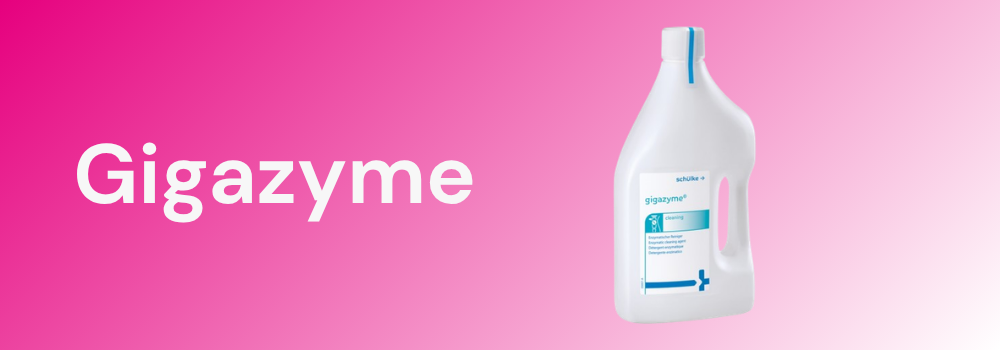
An enzymatic detergent which has been designed for manual reprocessing. This manual reprocessing is often performed on delicate or sensitive medical devices such as flexible endoscopes. This material compatibility means that it is great for use on even fine surgical instruments.
Benefits of Gigazyme -
- Non-foaming.
- PH-neutral, which helps to improve the longevity of your suction pump.
- Powerful cleaning.
Gigasept® instru AF
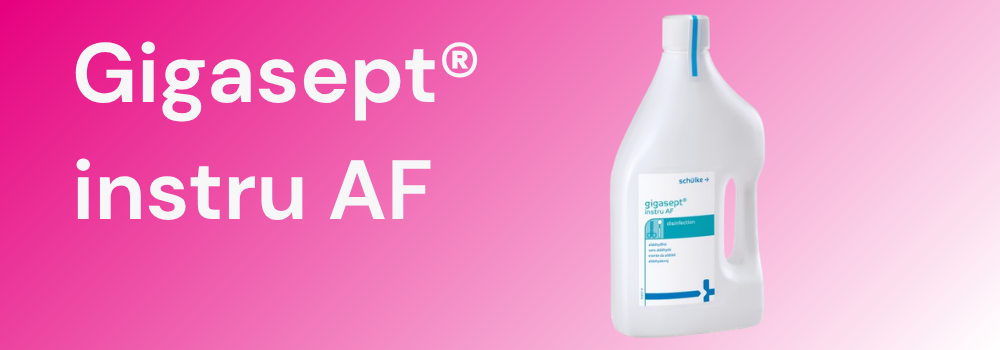
An aldehyde-free alternative for manual cleaning and disinfection of thermostable and thermolabile instruments of all kinds, such as flexible endoscopes. Gigasept® instru AF demonstrates a powerful cleaning performance, especially in ultrasonic baths. The microbiological efficacy gigasept® instru AF means that this cleaning liquid offers all of the important product features one might expect for instrument reprocessing in hospitals and practices.
Benefits of Gigasept® instru AF -
- Aldehyde-free.
- Broad spectrum of microbiological efficacy.
- Shortened contact time in ultrasonic bath.
- Suitable for manual cleaning and disinfection of thermostable and thermolabile instruments of all types (excluding flexible endoscopes).
Bossklein
Bossklein is more than just an imposing name, they’re one of the most well-respected specialist brands for disinfection. Bossklein rigorously test each of their products to meet or exceed regulatory guidelines. The catalogue offered by this company is quite broad, with products specialised to maximise their cleaning efficacy and material compatibility.
Bossklein’s tests include following standards: EN 14885, EN 14476, EN 14562, EN 14561, EN 13727, EN 13624, EN 1040, EN 1276, EN 1275 and DGHM guidelines.
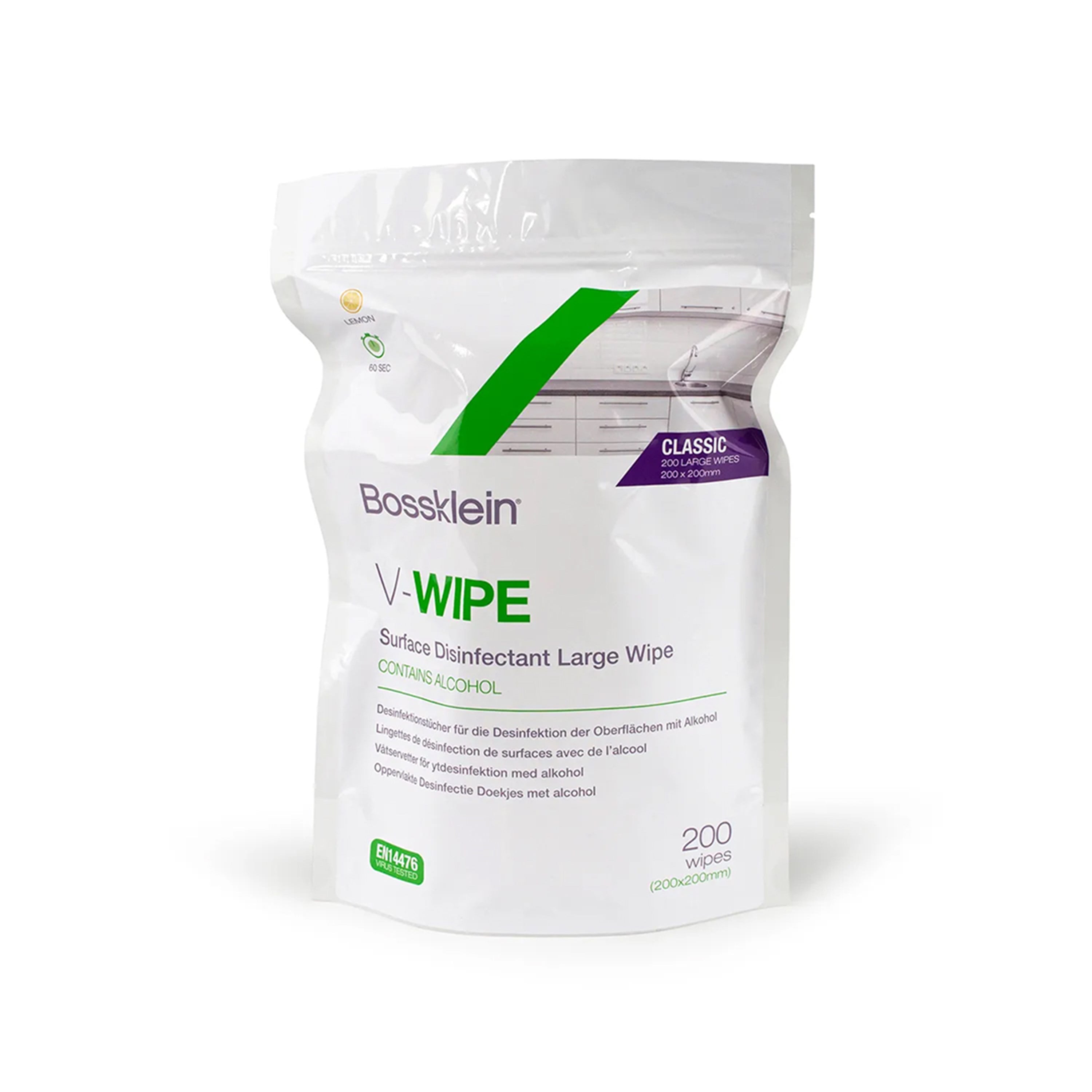
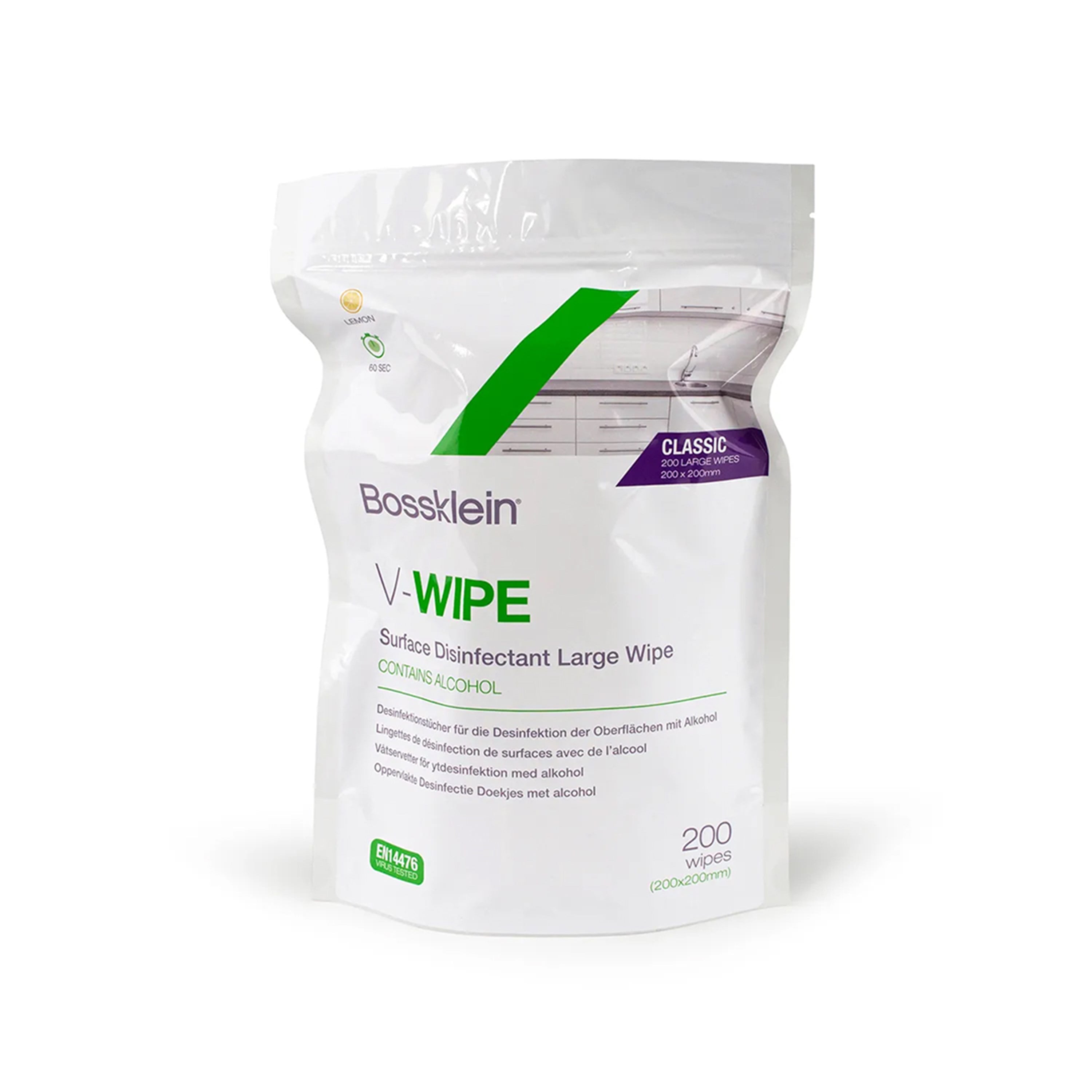
V-Wipes
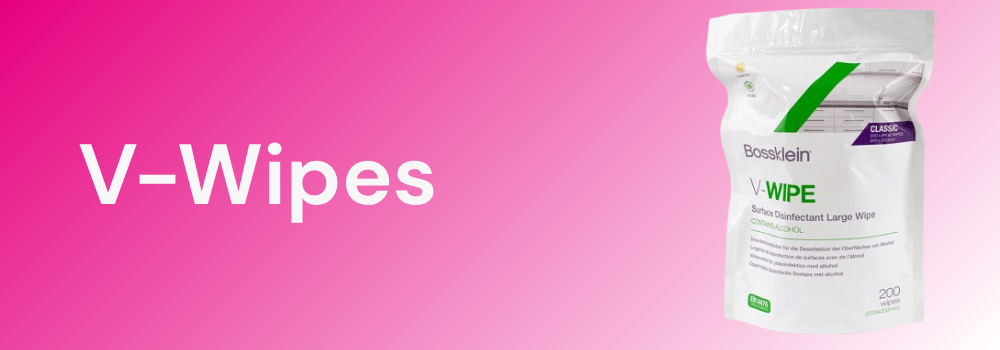
Versatile disinfectant cleaning wipes, Bossklein V-WIPES are suitable for use on non-pourous and alcohol-resistant surfaces. With a contact time of just 60 seconds, these wipes are great for cleaning between patients, and are well-suited for use in busy practices. The formula for V-Wipes is particularly powerful, as its 63% alcohol-based formulation ensures effective microbial action, making them perfect for controlling infections on resistant surfaces in clinical environments. Effective against all Bacteria and Yeast, this formula has been tested against EN standards for proven effectiveness including Phase II Step I and II.
Benefits of V-Wipes
- Alcohol based formulation 63% Ethanol w/w (70.5% v/v).
- Contact time of only 60 seconds.
- Wide effective spectrum.
- Effective against Coronavirus, HIV, Hepatitis, Influenza, TB, Adeno and Noro viruses in just 60 seconds.
IMPactiv P Impression Disinfectant Powder
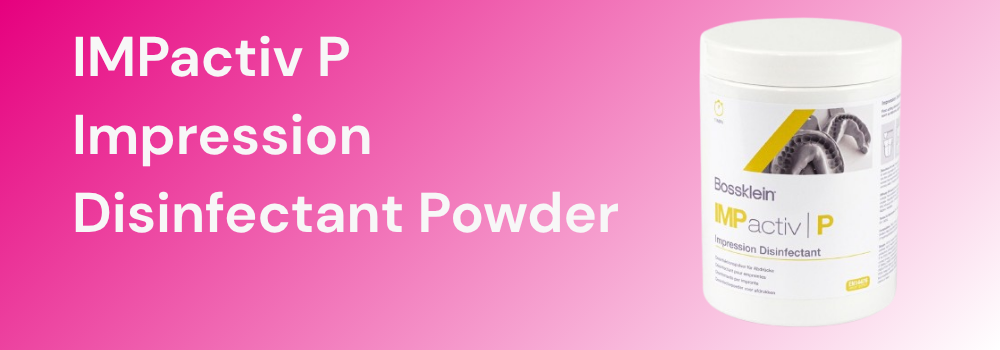
We haven’t discussed dental impressions yet, as that could well be its own article. Despite this, decontamination and disinfection of dental impressions is absolutely vital to avoid cross-contamination during application, processing and transport. Additionally, disinfection helps to improve the surface quality of the impression itself.
Being suitable for use on all kinds of impression materials such as silicones, alginates, polyether as well as for orthodontic impressions, Bossklein IMPactiv disinfectant powder helps to keep your staff, patients, and impressions safe. The powder’s unique composition is formulated to clean and disinfect dental impressions without influencing mould stability or shape.
IMPactiv P Impression Disinfectant Powder Brochure
Benefits of IMPactiv P Impression Disinfectant Powder
- 2% concentrate (20g/1L).
- Fast acting – only 60 seconds.
- Safe to use on all impressions.
- Highly effective formula.
- Kills Coronavirus.
Shop IMPactiv P Impression Disinfectant Powder
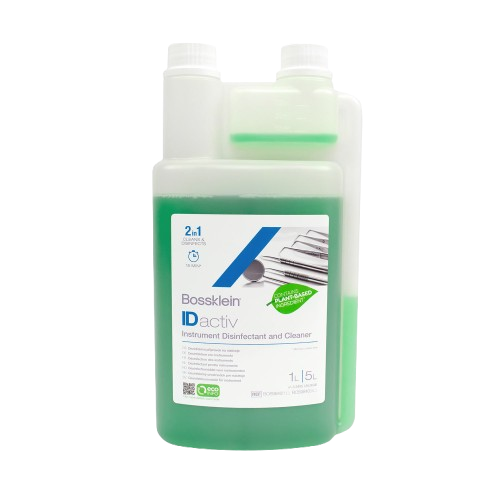
IDactiv Instrument Disinfectant and Cleaner
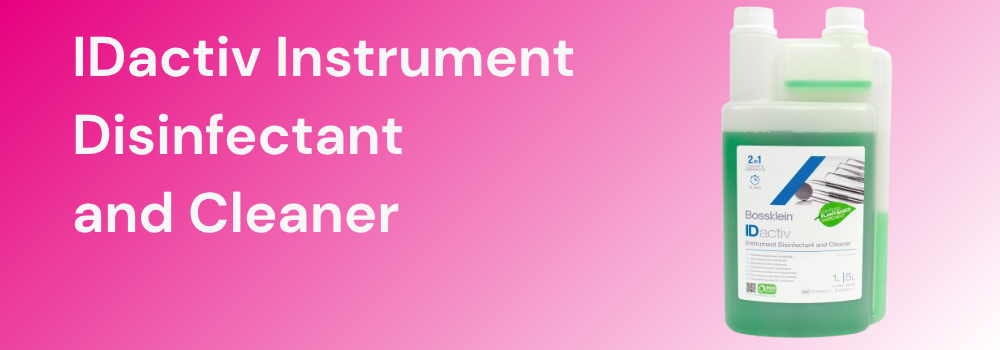
Used to manually disinfect a variety of instruments before sterilisation. This includes endodontic items, burs, and tools. The formulation of this disinfectant and cleaner means it demonstrates high levels of efficacy and material compatibility, meaning it’s even safe to use inside some instruments, as well as use within ultrasonic baths. As a cleaner-disinfectant, it removes debris from instruments and kills microorganisms which remain on the surface too.
To discuss IDactiv’s material compatibility a little more, this cleaner-disinfectant is compliant with EN 21530, which ensures compatibility with a wide range of different materials while preserving instrument quality. Partly due to its chloride-free formulation and the inclusion of a corrosion inhibitor to help ensure any instruments and tools remain in top condition after disinfection.
Bossklein IDactiv is PHMB-free, and includes less hazardous or environmentally impactful chemical components. One example of this would be its plant-based chelating agent, which helps to make handling and usage much safer for the user and environment. IDactiv’s highly effective formula has been tested to real world EN standards for proven effectiveness including Phase II Step I and II.
IDactiv Instrument Disinfectant and Cleaner Brochure
Benefits of IDactiv Instrument Disinfectant and Cleaner
- Disinfects instruments and tools.
- Use inside instrument bath or ultrasonic bath.
- Short soaking time, from only 15 mins.
- Wide material compatibility.
- Low hazard classification.
- Virus tested.
- Active against TB.
- 2% or 4% dilution ratio.
- Proven efficacy against all enveloped viruses inc Coronavirus, Hepatitis B and C and HIV. It is also active against Bacteria, Yeast, Tuberculosis and non-enveloped Viruses Adenovirus and Norovirus.
Shop IDactiv Instrument Disinfectant and Cleaner
SDactiv ZERO Surface Disinfectant
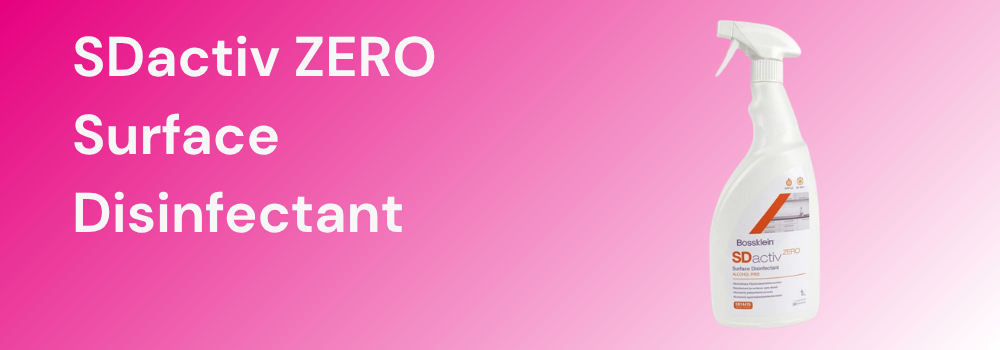
A 63% alcohol-based formulation which provides strong antimicrobial action, in a short 60-second contact time. Perfect for enhancing infection control in busy dental practices between patients and procedures. This disinfection spray has been designed for use on non-invasive medical device surfaces within the dental environment. If you’re looking for a general-use disinfectant spray, as well as one which is well-suited for disinfection in a dental environment, the SDactiv ZERO Surface Disinfectant has been dual-registered as a Class IIa medical device, which can be used to disinfect non-invasive medical devices and as a general purpose Biocide.
SDactiv ZERO Surface Disinfectant Brochure
Benefits of SDactiv ZERO Surface Disinfectant
- Alcohol based formulation 63% Ethanol w/w (70.5% v/v)
- Fresh lemon aroma
- Contact time of only 60 seconds
- Wide effective spectrum
- Ready to use solution
- Clear in colour
Shop SDactiv ZERO Surface Disinfectant
Clinell
One of the largest UK-based cleaning brands, Clinell was only founded about 20 years ago in 2006, but they have quickly attained international respect as a brand which takes cleaning and disinfection very seriously. Clinell has seen widespread adoption throughout the NHS and other UK businesses thanks to their wide range of products which spans across clinical and domestic contexts.
Clinell Universal Cleaning and Disinfectant Wipes for Surfaces
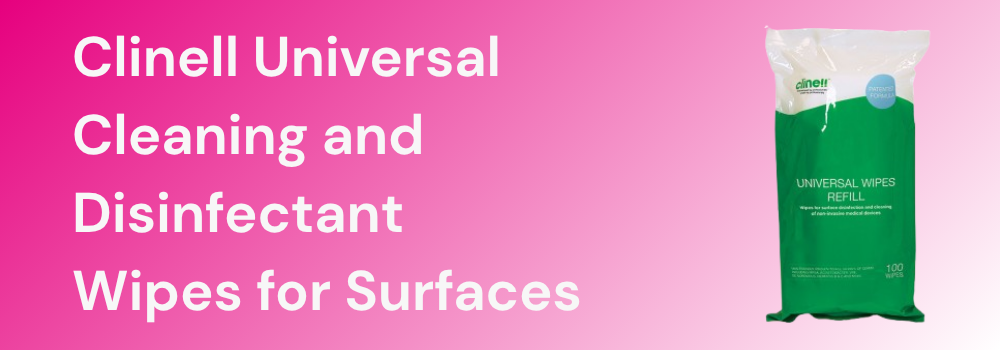
With an impressive contact time of just ten seconds, these alcohol-free wipes have seen widespread adoption across practices throughout the UK. Being alcohol-free, they are suitable to use on alcohol-sensitive surfaces, without losing their efficacy, being able to eliminate 99.99% of germs from any surface. When we say 99.99% of germs, we mean that Clinell has been tested to EN 1276, EN 14476, and EN 1650, which means respectively these wipes have passed tests for effective bactericidal activity, fungicidal activity, and virucidal activity.
A nice addition when considering Clinell Universal Cleaning wipes is that they can be used without gloves. This is very convenient for practitioners, since you don’t need to don a fresh pair of gloves to disinfect and clean surfaces in the practice.
Clinell Universal Cleaning and Disinfectant Wipes for Surfaces Page
Benefits of Clinell Universal Cleaning and Disinfectant Wipes for Surfaces
- Powerful Multi-Purpose Cleaning
- Contact time of 10 seconds.
- Convenient for regular hygiene maintenance.
Shop Clinell Universal Cleaning and Disinfectant Wipes for Surfaces
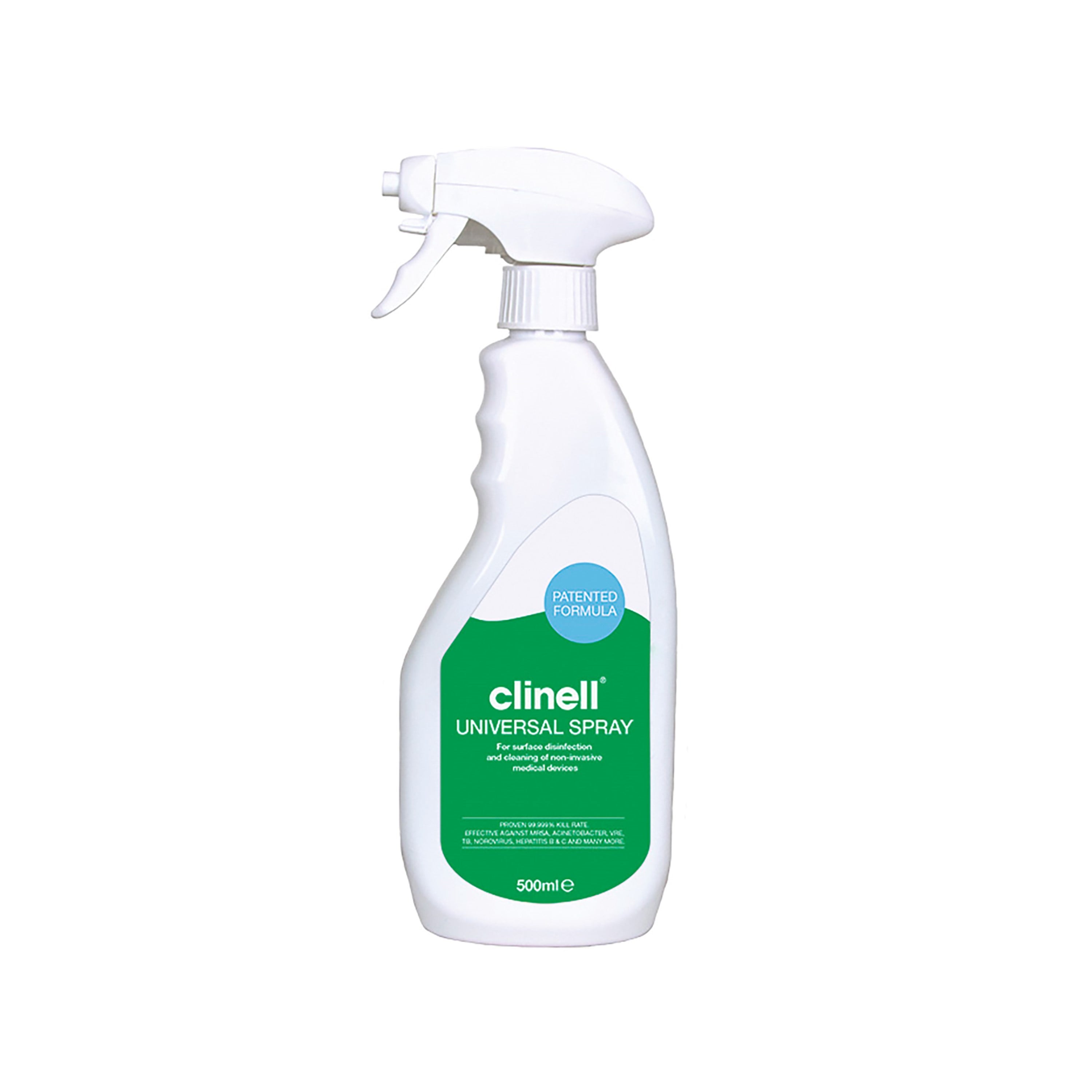
Clinell Universal Cleaning & Disinfectant Spray
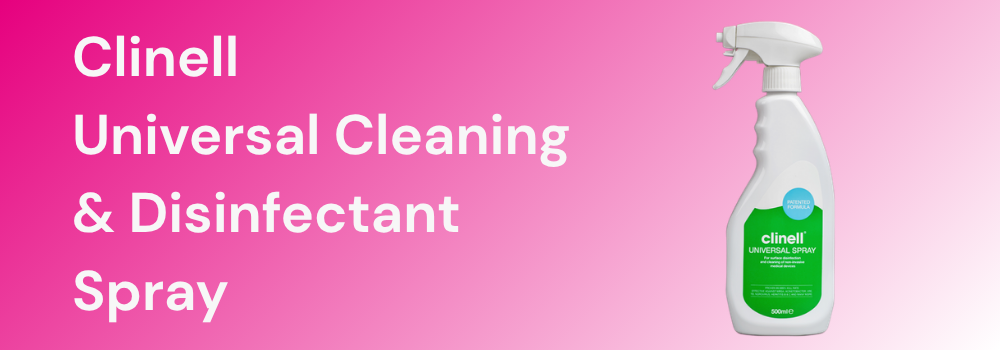
Similar to the Clinell Universal wipes in that it demonstrates a 10-second contact time and a biocidal formula with a 99.999% efficacy rate against bacteria and viruses, but this time in a bleach and residue-free spray bottle. This spray is used in domestic settings, but also for disinfecting worktops, handles and medical equipment. The residue-free formula helps to ensure that no deposits or soils are left after cleaning. Perfect for use between patients in busy, active practices.
Clinell Universal Cleaning & Disinfectant Spray Page
Benefits of Clinell Universal Cleaning & Disinfectant Spray
- Bleach-free formulation – perfect for patients with bleach sensitivities
- Biocidal formula kills 99.999% of bacteria and viruses in 10 seconds
- No-Rinse leave-on formulation.
- Made using Quaternary ammonium compounds (QACs), specifically selected for their broad-spectrum efficacy against diverse pathogens and safety profile.
Shop Clinell Universal Cleaning & Disinfectant Spray
Clinell Antimicrobial Hand Wipes
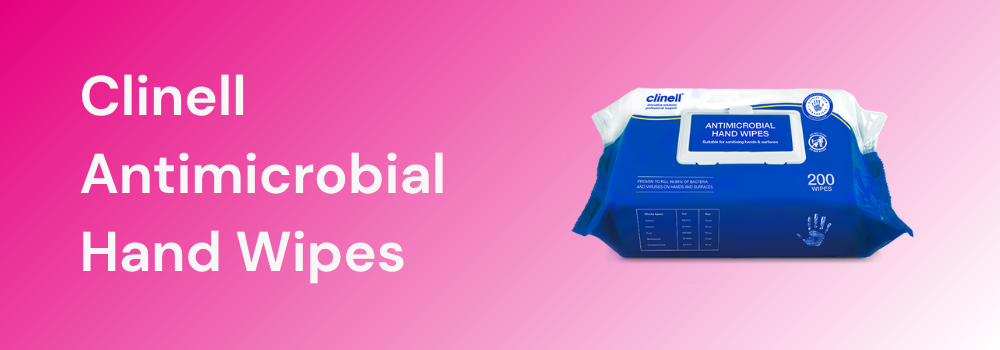
These hand wipes are formulated for use on your hands, as well as surfaces. Offering a 30-second contact time for disinfection, and still demonstrating a 99.99% elimination rate for bacteria and viruses on contact. These wipes come in a smaller size, which minimizes waste while maintaining Clinell’s signature strength and quick 30-second disinfection performance.
Clinell Antimicrobial Hand Wipes Page
Benefits of Clinell Antimicrobial Hand Wipes
- Broad-spectrum activity, rapid action, and favourable safety profile when used as directed.
- Contains Glycerine, a powerful humectant for attracting and retaining moisture in the skin.
- pH ranging between 4.5 to 5.5, which is gentle on the hands and surfaces
- Laboratory testing (EN 1276, EN 1650, EN 14476) demonstrates that the wipes achieve at least 99.99% reduction of test bacteria within 30 seconds of contact time.
Practice Wraps, Bibs, Barrier film, and Barrier Systems
In practices, there are ‘high-touch surfaces’, which as the name states, are surfaces which you’ll use a lot. Light switches, chair controls, curing lights and so on. To help protect these surfaces from contamination –and so save decontaminating them after every single use – single-use barriers are used instead. For curing lights, you might use a curing light sheath or cover, for other surfaces you’ll use barrier film, and for clothes and personal affects, there are scrubs and bibs.
One of the biggest benefits of bibs and barrier film is that they save you a lot of time. Solely relying on chemical disinfection alone is comparatively labour-intensive and leaves more room for error. Whereas single-use barriers systems can be easily placed, discarded, and the surfaces underneath will likely require less effort to clean when necessary.
There are two types of barrier system:
- Sterile barrier systems.
- Non-sterile barrier systems.
Non-sterile barrier systems are by far the most common, these are sheets of material – often plastic- which are a few microns thick and impermeable. This makes them very useful as a mechanical barrier between you, your clothes, or the surfaces of your dental practice, and potential contaminants from your patient. Whether this might be aerosols or blood spray.
Sterile barrier systems are used to package sterile equipment, meaning you’ll likely receive pre-sterilized instruments in packaging which is a sterile barrier system. Additionally, sterile barrier systems are used to store anything that has been recently autoclaved for use.
FAQ - What Kinds of Sterile Barrier Systems are there?
If you’re looking for a summary of sterile barrier systems, consider looking into the summary provided by BS EN ISO 11607-1:2019, which discusses the barrier systems sealing in sterilised objects such as surgical instruments. These are listed below:
1 - Flexible peel pouch. This is typically supplied sealed on three sides with the remaining side open for the insertion of dental instruments.
2 - Pre-formed rigid tray with die-cut lid. These trays are potentially suitable for use with displacement or vacuum sterilizers. Subject to manufacturers’ instructions, the trays may
3 - Sterilization bag: Sterilization bag. This is constructed from porous medical paper and sealed before sterilization of the contents. The bag is essentially designed for use with vacuum sterilizers.
4 - Header bag. This is manufactured as a sealed bag with a heat-sealed permeable closure, which can be peeled off.
5 - Form/Fill/Seal (FFS) or Four-Side-Sealing Products. In larger-scale operations, automated systems such as form/fill/seal (FFS) or four-side-sealing products are also an option for use.
Sterilisation and its place in the dental practice
We’ve briefly touched on sterility in a previous article, Dental Bur Maintenance and Sterilisation Tips, but it’s worth going over it again here. While disinfection and cleaning are two concepts we’ve discussed previously, sterility has been left out because unlike either of those two procedures, sterility requires that any and all microorganisms on a surface be killed. This is very different when compared to disinfection, which specifically targets harmful microorganisms.
In the dental practice, there are limited and specific instances where sterility is required, these being summarised best by HTM 01-05
““Sterile” and “sterilized” As the environment in which dental instruments are used is not sterile, it follows that dental instruments will not be sterile at the point of use.
(They should, however, be in a sterile state at the end of the decontamination process when the sterilizer door is opened.)
Accordingly, this guidance accepts that dental instruments may be defined as “sterilized” rather than “sterile” at the point and time of use (a somewhat different approach from that in invasive surgical procedures). In some instances, the decontamination process may not generate full sterilization, for example in the reprocessing of dental handpieces; however, the guidance will nevertheless seek to raise standards and minimise infection risk.”
Autoclaves and Washer-Disinfectors
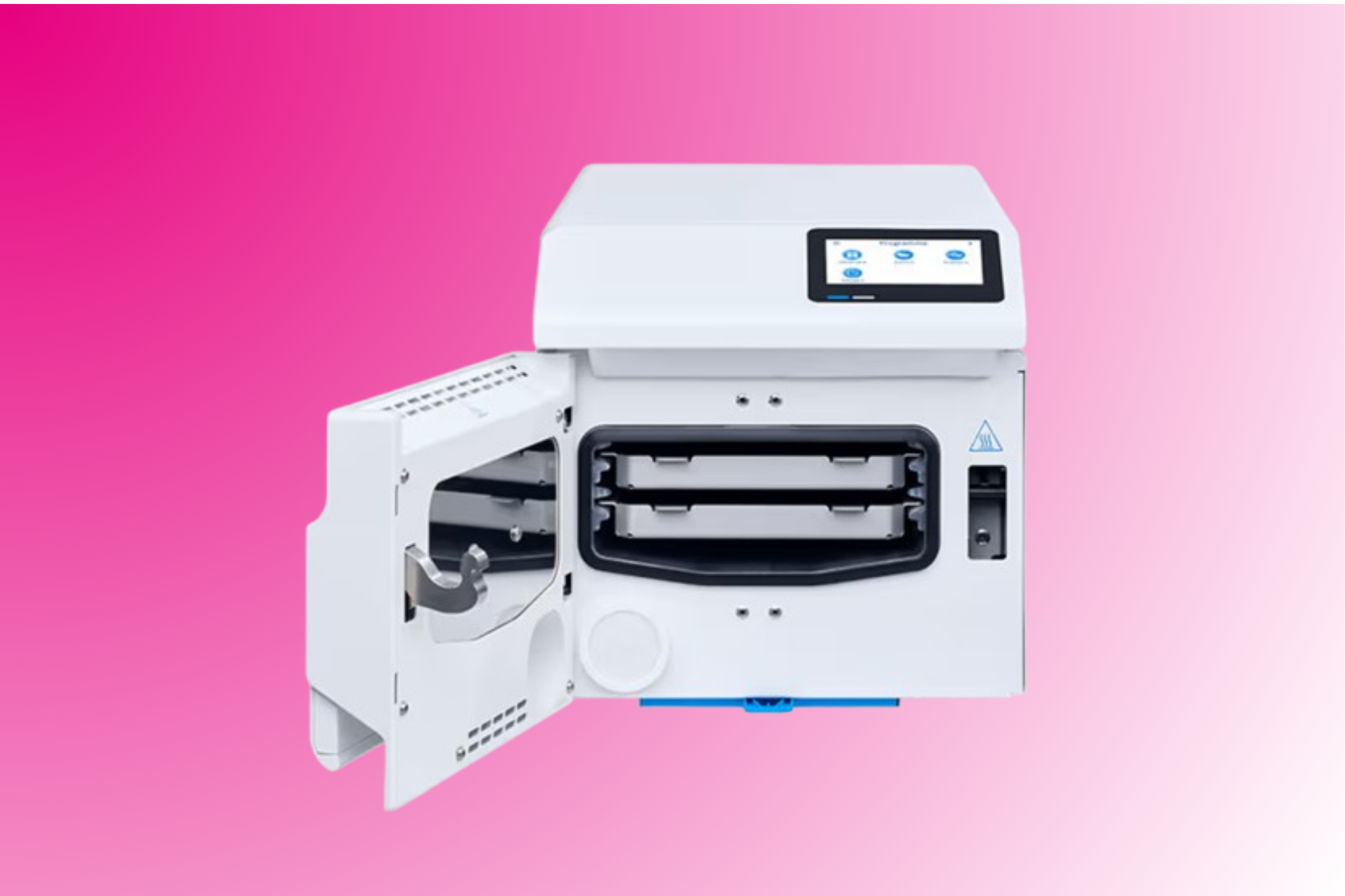
If you’re looking to disinfect and clean dental equipment, you’ll need an autoclave. Each autoclave is different, and will have different instructions for loading, temperature and cycle length. Please always refer to manufacturer instructions and guidance when using an autoclave.
There are several different types of autoclaves, benchtop autoclaves have three types. Type N, Type B (vacuum), Type S. Type N autoclaves function by utilising high-pressure steam and are used on non-wrapped sterile instruments. Type B have an additional vacuum stage, making them suitable for hollow, air-retentive and packaged loads. Finally, Type S autoclaves are specialist, and used to reprocess specific equipment.
Instrument washer-disinfectors typically have six steps, these being: flush, wash, rinse, thermal disinfection, drying, records.
Flush – This is removal of the largest deposits and material which may be on the instrument, blood etc.
Wash – This is a finer cleaning stage, where removing soil is removed via the application of a sufficiently-powerful detergent.
Rinse – This is when the detergent is washed off of your instrument using high quality-water.
Thermal Disinfection – High-pressure steam is used to heat your instruments to a sufficient temperature which will prevent any microorganisms from existing on its surface.
Drying – This is a brief stage where, after steam is applied to your instrument, the instrument is allowed to dry.
Records – This is where the instruments that have been cycled, the time of the cycle etc are all noted by the User in a washer-disinfector logbook or record. This helps to keep practices compliant and protect patients in your practice, as you have a record detailing the temperature and time a piece of equipment has been processed at, documenting its sterility.
Conclusion.
Cleaning, disinfection and sterilisation are the processes by which a practice is made safe for patients and practitioners. There’s always going to be a lot to consider when trying to stay on top of practice hygiene, but you aren’t alone. You have guidance from official bodies, your colleagues in the dental practice behind you, and plenty of equipment and consumables which can help you to keep your practice clean and safe for all.