3 in 1 tips are a simple, yet necessary component within the modern dental practice. Used for the precise application of water, air, or spray, which can help to irrigate, cool, dry, or generally clean surfaces and tissues within the mouth.
These tips are ubiquitous with modern dental practices, you’ll struggle to find a practice or a practitioner who doesn’t handle 3 in 1 tips on a regular basis, but how do you get the most out of them? How do you find a brand that works with your needs, and doesn’t leak, and handles ergonomically? We’re sharing our three top tips on how to choose and use 3 in 1 tips in your dental practice, we’ll also be talking about a few leading brands and what makes them stand out compared to any more generic tips.
What Are 3 In 1 Tips?
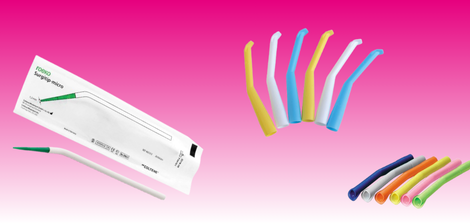
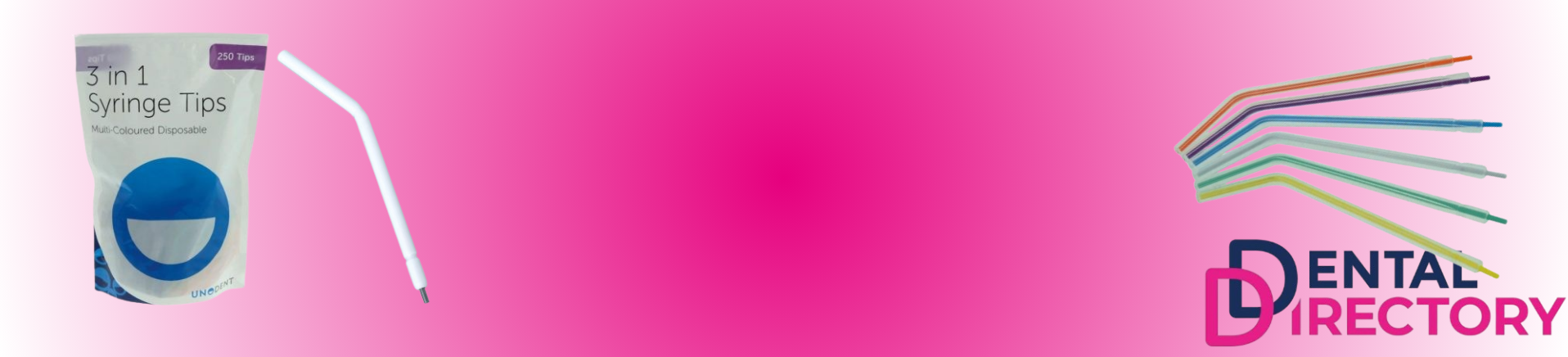
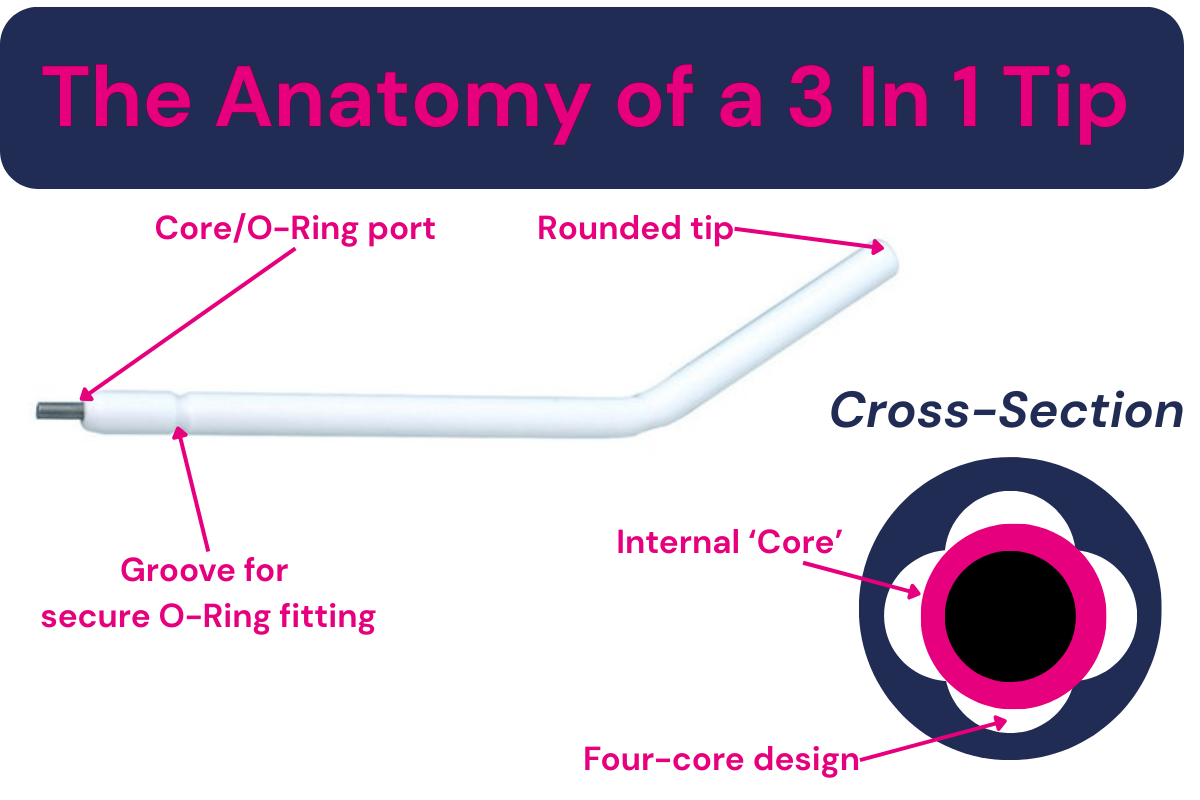
We’ll start by outlining what are the key components of a product before launching into further analysis. 3 in 1 tips are a length of tubing with several smaller internal cannulas for the respective application of water, air, and a mix of the two. If you need a visual, please find one below:
3 in 1 tips are designed to fit to air/water handpieces, air-water syringes, and dental water spray guns. Some of these are only compatible with certain types of 3-in-1 tips, and some handpieces may need a specialist tool to work with your chosen brand of 3 in 1 tip. However, there are some products which title themselves as “universal” 3 in 1 tips, and can be used across a broad range of handpieces.
3 in 1 tips consist of an outer tubing, and an inner series of cores. There’s a four-core exterior surrounding an inner tube. These syringes often tend to have a groove to help them fit to your handpiece’s O-ring, as well as an internal core protrusion or “port” to attach to your handpiece’s internal piping. Finally, these 3 in 1 tips have a rounded tip.
The Benefits of Autoclavable 3 in 1 Tips –
Being reusable, these tips are better for the environment, and can end up saving your practice money. If you manage to look after an autoclavable 3 in 1 tip for long enough you may be able to get more use out of a single pack than out of multiple packs of single-use 3 in 1 tips. One thing to note about autoclavable 3 in 1 tips is that their small internal channels may not be properly sterilised, even by a full autoclave cycle.
The Benefits of Single-Use 3 in 1 tips –
Single-use 3 in 1 tips are convenient to use, often come pre-sterilised, and are more immediately cost effective than autoclavable 3 in 1 tips. Finally, you don’t need to spend time processing single-use 3 in 1 tips, you just need to simply apply them and go.
Our Top 3 tips for 3 in 1 tips:
1 - Check Compatibility, then check again!
Not all 3 in 1 tips are compatible with all handpieces! For example, one of our brilliant UnoDent products, the ‘UnoDent 3 in 1 Syringe Tips Disposable’ is only compatible with DCI (Push ring) and Adec triple syringes. When checking compatibility, it’s important to check whether the 3 in 1 tips you’re using are American-style or European style.
American Style 3 in 1 Tips – These are the standard 3 in 1 tip style, they tend to be longer, and have different thread tips.
European Style 3 in 1 Tips - These are shorter syringe tips, and they have different thread tips, meaning they will not be compatible with american style 3 in 1 tips unless converted.
As mentioned previously, many syringe tips also utilise adaptors, which help to connect the syringe tip to its handpiece. Always make sure that your adaptor is compatible with your handpiece and 3 in 1 tip.
2 - Don’t cross the streams! Water and airflow management.
Some 3 in 1 tips deliver air and water through the same channel, or through channels which have a deal of crossover. These 3 in 1 tips are typically an economic alternative, being cheaper than other syringe tips, but regardless, this crossover is to be avoided. A lack of division between air and water flow will decrease stream control and prevent accurate drying.
Keeping air and waterflow seperate comes down to a matter of the internal channels utilised by a 3 in 1 tip. Four-core channels, such as those used in UnoDent Disposable Multi-Colour 3 in 1 Syringe Tips, help to ensure that air, water, and mist channels are all kept clear.
3 - Consider disposable 3 in 1 tips.
While there are several 3 in 1 tips which can be autoclaved, this autoclaving will likely not fully sterilise the channels within. While re-usable metal tips make a great alternative when non-sterile syringe tips are appropriate, if you’re looking to use sterile air and water, you should consider utilising a disposable 3 in 1 tip. If the waste this produces concerns you, there are several products which are made using recycled or more ecologically friendly material which you can find in the FAQs below.
What should I look for in a 3 in 1 tip?
The perfect 3 in 1 tip is elusive, not every circumstance and dentist looks for the same benefits from their tools. However, there are still some general rules of thumb to consider when making a 3 in 1 tip purchase.
Compatibility – Are you looking for european-style or american style 3 in 1 tips? Are the 3 in 1 tips you’re looking to purchase compatible with your specific type of handpiece? The perfect syringe tip for you meets all of these conditions.
Cost – No-one likes spending money. However, to access the higher quality dental goods, you'll need to evaluate the cost vs its benefit to you. We’d recommend springing for a multi-pack of four-core syringe tips with rounded edges.
Rounded edges – A patient’s mouth is filled with soft tissues, and if your 3 in 1 tip has hard or jagged edges, it can inflame or damage those tissues and lead to many more complications. As a result, look for 3 in 1 tips with rounded edges.
Adaptor fittings – Does this 3 in 1 tip need an adaptor? Sometimes a syringe tip doesn’t need adaptors to bridge the gap between itself and a handpiece, which helps to cut down cost and hassle.
Length, Access, maneuverability, and visibility – Finally, if you’re looking to use a 3 in 1 tip, you’ll want to be able to see where it’s going, and use it with accuracy. Make sure your 3 in 1 tip isn’t too short, long, or cumbersome for your particular tastes and use case.
What did dentists use before syringe tips?
Before 3 in 1 syringe tips became widely-used across dental practices, dentists used a variety of different methods to deliver air or water during procedures. These were all far less efficient and hygienic than modern techniques.
Separate Air and Water Devices
- Air Blowers:
Foot-powered or hand-operated bellows were used to deliver air. These devices would puff air onto the tooth surface to dry it before restorations. This was quite energy-intensive, and created a host of cross-contamination issues. - Water Syringes:
Small handheld metal syringes, or squeezable bottles filled with water were sometimes used to deliver water for rinsing. - Cotton Rolls and Gauze for Drying:
Before reliable air delivery, dentists relied heavily on cotton rolls, pellets, or gauze to physically absorb moisture from the working area.
This was more time-consuming and less effective, especially when a perfectly dry field was needed for bonding or cavity preparation.
Old-school Saliva Ejectors
The first models of saliva ejectors (introduced in the 1930s–40s) helped to remove fluids from a patient's mouth, but couldn’t simulate the drying power of a targeted air stream.
Alternating Rinse and Suction
Assistants would alternate between manually rinsing the patient’s mouth with a hand syringe and suctioning — meaning more handoffs and longer procedure times.
When the 3 in 1 syringe was introduced between 1960 and 1970, it combined air and water into one instrument. This made procedures much faster, and accurate. Additionally, when the means of accessing single-use tips came about, it helped to solve the issue of cross contamination. 3 in 1 tips are one of many instances of innovation in the dental industry and their impact on history – and your practice – shouldn't be ignored!
FAQ
Where can I find eco-friendly 3 in 1 tips?
Plastic waste is an unfortunate part of modern dentistry, but that doesn’t mean we have to accept it. While we currently don’t sell eco-friendly 3 in 1 tips, we are looking to expand our range shortly. Watch this space!
Should I use a disposable or a reusable 3 in 1 tip?
Disposable 3 in 1 tips are well-suited for work which requires sterility or a minimal chance of cross-contamination. For that reason, they are often considered the superior choice in dental work.
How do I know if my reusable 3 in 1 tip needs maintenance?
Any change in the water, air, or mist flow from your 3 in 1 tip likely indicates a clog or deterioration of an interior chamber.
My patient has a stubborn debris deposit, how do I get rid of it with my 3 in 1 tip?
If you find your patient has a stubborn pocket of debris which can’t be shifted, you can use both air and water at the same time, this might provide just that little bit extra amount of force required to shift deposits.