What is Biodentine XP?
There's a lot of pressure on bulk fill restoratives; the posterior teeth need to be exceptionally strong and durable to withstand the daily grind - especially if your patient has bruxism. However, when it comes to the restorative range Biodentine XP, you can rest assured that your restoration material will meet expectations. Billed by Septodont as " The first all-in-one dentine substitute to fully replace dentin" Biodentine XP is a range of two different products (XP 200 & XP 500) which can provide easy direct placement, long-lasting restorations, and exceptionally high levels of biocompatibility. Today we'll be exploring both products in finer detail and examining what makes them such an exceptional material for bulk fill procedures and more.
If you don’t know about us, we’re Dental Directory. We’re a dentistry supplier who’ve been supporting practices for the last fifty years. We do training, equipment, products, and even full surgery kit fit outs. Once you’re done with this blog, why not see what we can do for you?
Bioreactivity and Biodentine
Biodentine is made using extra-pure CS3 and contains 0 resin. When application of Biodentine was studied, 0 cell death was recorded, and the restorative maintained a pH of 10.99 at release and pH >11 for 28 days. This helps to create an unfavourable environment for bacteria which may cause pain or the development of caries. Additionally, the no-resin formulation of Biodentine means that it demonstrates 0 shrinkage, maintaining long-lasting dimensional stability. This helps to ensure a tighter coronal seal and encourage longevity in the restoration.
The superior bioreactivity of Biodentine brings a variety of benefits. Firstly, it can be placed directly on the pulp. It even interacts well with pulp cells, helping to create a dense dentinal bridge formation to protect the pulp, and remineralise damaged dentine. This makes the surrounding dentine much stronger, while protecting your patient's pulp and potentially saving tooth structure through remineralisation.
Ultimately, the bioreactivity and biocompatibility of biodentine help to create stronger restorations, and potentially save teeth for patients. Septodont estimate that a staggering 6.5 million teeth have been saved with Biodentine. That's millions of patients who have left their procedures with their existing teeth preserved because of their practitioner's skillful use of Biodentine.
How do I apply Biodentine XP?
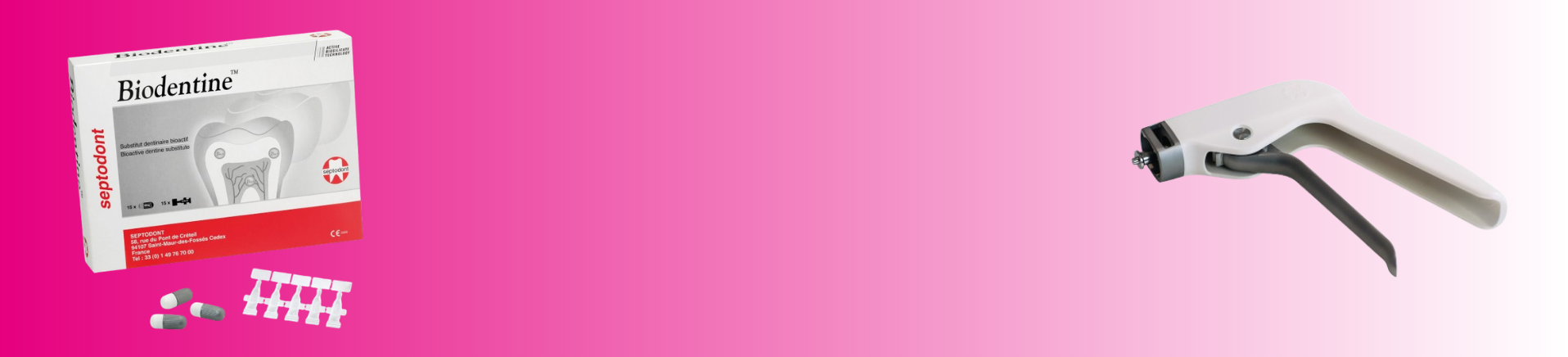
Biodentine XP uses an "all-in-one cartridge." This means it contains a cartridge filled with ready-to-mix power and liquid, ensuring less preparation, and guaranteed mix consistency. For crown indications, you can apply Biodentine directly into the cavity from the crown to the top thanks to the Biodentine XP gun and its orientable nozzle. Biodentine can be placed directly onto pulp and living tissues because of its 'Active Biosilicate Technology', which gives it excellent biocompatibility.
What can Biodentine XP do for my practice?
Biodentine XP is a pulp therapeutic and restorative. It is bioactive, biocompatible, antimicrobial, and demonstrates strong mechanical properties with a tight coronal seal. All of these factors mean that Biodentine is suitable for a unique 'Bio Bulk-Fill approach', which involves filling the cavity from the pulp upwards to the DEJ. The final enamel restoration can then be performed in the same procedure, or in a second session, anywhere from two weeks to six months later. This is a relatively unique approach to bulk fill procedures, but also a reliable one. Biodentine has been around for twelve years, and throughout those twelve years, this procedure has been successfully repeated and their outcomes recorded. Please see the below cases provided by Sepotdont.
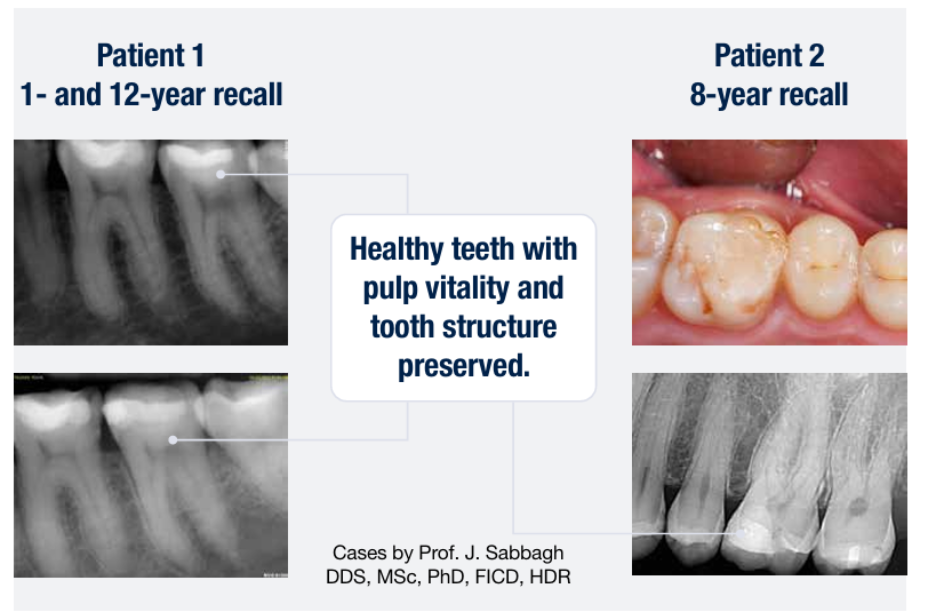
Biodentine has a wide variety of indications, many of which are relatively common for patients, these being:
- Deep cavities
- Pulp exposure
- Pulpotomy
- Root repair procedure
Additionally, further studies show that Biodentine demonstrates a clinical success rate of 96.4% for direct pulp capping, 93.9% for Pulpotomy, and 95.8% for Indirect pulp capping (when dentine thickness is less than 0.5 mm and difficult to determine in a clinical setting).
This all means that Biodentine and be used pretty broadly across its indications as a highly biocompatible and bioactive intervention. Which is incredibly helpful for patients and practitioners alike. Patients are able to benefit from a high-quality dentine substitute, and practitioners have a product which is very easy to apply, and broadly helpful across multiple different cases.
To answer the question posed at the heading of this section, Biodentine can help you to provide a high level of care for patients with a wide variety of cases. Its one-step cavity filling procedure is time-saving, cost effective, and allows for less opportunity for error.
Shop Biodentine with Dental Directory
FAQ
What's the difference between Biodentine XP 200 and Biodentine XP 500?
The only difference between Biodentine XP 200 and Biodentine XP 500 is volume. Biodentine XP 200 contains a lower cartridge volume than Biodentine XP 500, making it better-suited for deep cavities, whereas Biodentine XP 500 is more useful for multiple sites or complex cases.
Should I use Biodentine XP 200 or Biodentine XP 500?
Consider the case, including factors such as cavity depth, number of restorations and material needed. If you need less material, you should use the Biodentine XP 200. If you require more, consider the Biodentine XP 500.
What are the indications of Biodentine XP?
Septodont separates Biodentine's indications into two categories, indications in the crown, and indications in the root, they are as follows:
Biodentine indications in the crown: temporary enamel restoration, permanent dentin restoration, deep or large carious lesions, deep cervical or radicular lesions, pulp capping, pulpotomy.
Biodentine indications in the root: root and furcation perforations, internal/external resorptions, apexification, retrograde surgical filling.