What is SDI Stela?
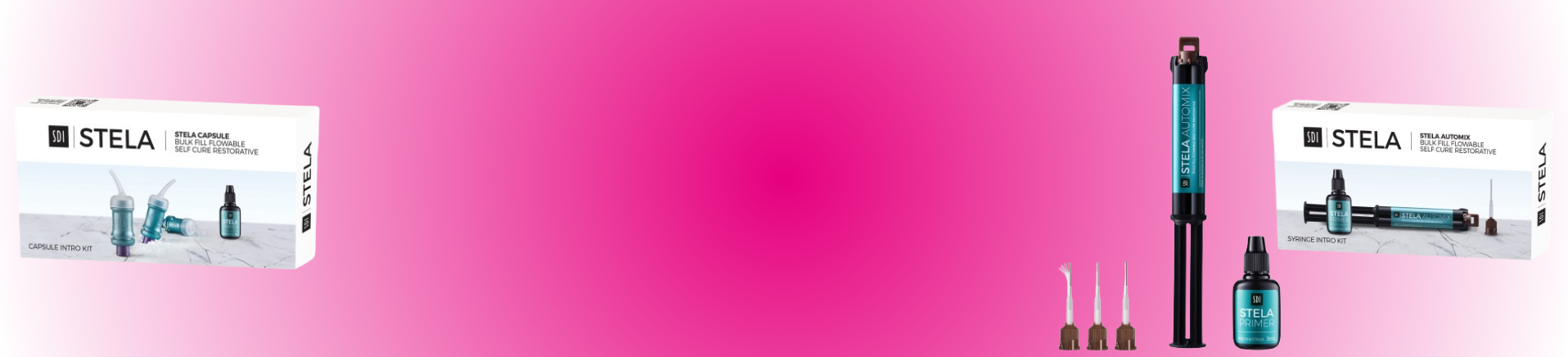
Presented by SDI, its parent company with the tagline "Faster, simpler restorations." SDI Stela is a self-cure composite system which has been impressing dentists around the globe for its unlimited depth of cure, high bond strength, and simple application procedure. Billed as an alternative to amalgam, SDI Stela is high-performing composite, with unlimited depth of cure and low stress polymerisation for a gap-free interface - no etching or light curing required. It's also picked up several accolades, most notably winning the ‘New Product Launch of the Year’ category in the 2025 Dental Industry Awards. While all of these features may make for an undoubtably impressive composite, can it truly be called an alternative to amalgam? We'll explore this question and discuss the benefits of SDI Stela in this brief blogpost.
If you don’t know about us, we’re Dental Directory. We’re a dentistry supplier who’ve been happily supporting practices for the last fifty years. We do training, equipment, products, and even full surgery kit fit outs. Once you’re done with this blog, why not see what we can do for you?
Amalgam Vs SDI Stela.
Amalgam may have become less dominant in dentistry since the development of durable light-cure composite, but it is still a juggernaut in the field of dental care. Producing restorations for the posterior region which are tough, long-lasting, reliable, and comparatively affordable against composite. However, these benefits come at a cost, amalgam has seen increasing scrutiny from bodies such as the European Parliament because of its mercury-based formulation. Additionally, with its characteristic metallic appearance amalgam is far from esthetic or toothlike, making it less and less desirable for patients looking to keep up their teeth's natural appearance. Luckily, SDI Stela seeks to make up for Amalgam's shortcomings and equal its strengths in every respect.
Perhaps the most appealing characteristic of SDI Stela is its esthetic appeal – where amalgam is by far at its weakest. SDI Stela comes in a single universal shade which uses a ‘chameleon effect’ to match the appearance of surrounding dentine. This is an enormous point in SDI Stela’s favour as it saves the practitioner space on inventory management, time on shade matching, and still leads to high levels of patient satisfaction.
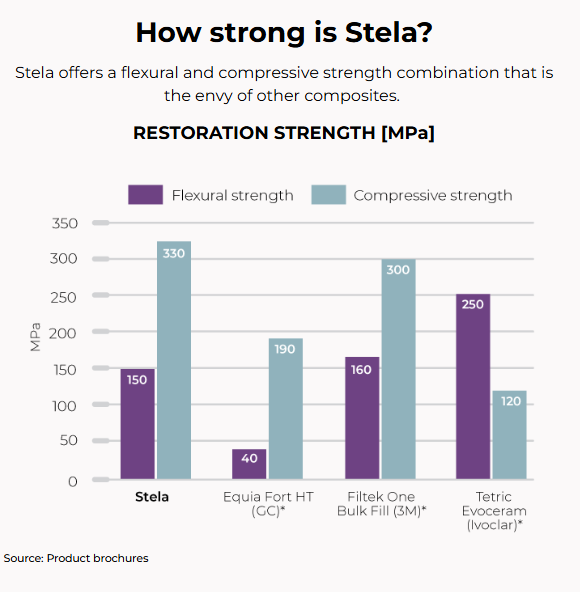
It’s not just aesthetics where SDI Stela excels, this restorative is also incredibly strong when compared to other composites. With a flexural and compressive strength of 143 and 331 MPa respectively. This strength exceeds many of its competitors and helps to ensure a safer, and longer-lasting restoration. This high level of strength means repeat visits from patients for repair are less likely, and higher levels of patient satisfaction and confidence are encouraged. See the chart below for a comparison between SDI Stela and its competitors:
The application process for placing Stela is designed to be simple, quick, and easily mastered. Utilising a version of the prime, etch, and bond system which only requires two steps and can be completed in about fifteen seconds! For comparison other prime, etch, and bond systems can take up to 120 seconds to complete and have about seven different steps. The steps for using SDI Stela are as follows, apply Stela Primer and complete your bulk fill procedure using an SDI Stela capsule or syringe, the composite will then self-cure within four minutes. This simplified process is excellent for nervous patients, as it reduces chair time. For practitioners it also has the added benefit of providing much less room for error than a typical composite application, as there is less from for a mistake to be made during the two-step process.
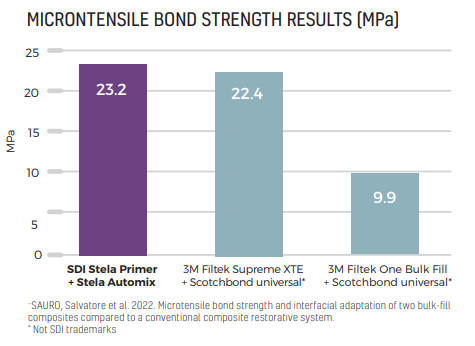
It's also worth mentioning that the bond strength that is provided by the Stela Primer is also extremely high, with a 2022 study by Salvatore Sauro placing its strength at 23.2 MPa, which puts it ahead of many of its other competitors. This strength is crucial in providing a long-lasting restoration, as the bond between a composite and its surrounding dentine is often one of the first potential points of failure for any restoration. Please see below for a graph detailing the strength of Stela Primer.
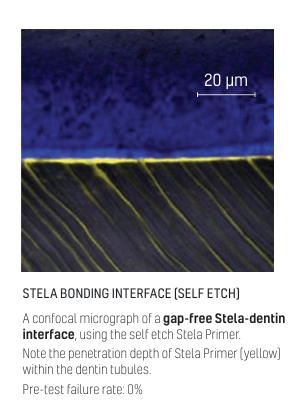
One factor that is always worth mentioning about a restoration is the potential for postoperative sensitivity. This sensitivity plays a huge part in how patients immediately respond to their restoration, and it can seriously impact their satisfaction if they find their teeth to be exceedingly sensitive in the days following a procedure. The gap-free interface of SDI Stela, however, works to dramatically reduce the chances and potency of postoperative sensitivity, as well as premature failure.
What are the Indications of SDI Stela?
SDI Stela has a range of clinical indications, which include:
- Class I, II, III and V
- Core build-ups
- Base or liner
- Sealing endodontic access cavities (particularly where light cannot access for light cure purposes)
How is SDI Stela Formulated?
SDI Stela is formulated utilising BPA-free resin monomers, optimized ionglass™ fillers ( which are SDI’s bioactive proprietary hybrid glass), and ‘specially surface-modified amorphous silica’. This triple formulation helps to encourage the composite’s high level of strength and esthetics, however its other outstanding mechanical properties come from how the composite cures. It rapid curing reaction is detailed as the following process by SDI:
“The Stela monomers form polymeric chains and, simultaneously, these chains are rapidly and densely cross-linked to each other, forming a complex web that strongly binds the ionglass™ filler and the amorphous silica, resulting in a strong and resilient restorative material. The Stela snap set fast cure is due to an innovative hydroperoxide-based initiation system that is free of tertiary amine. This ensures fast-setting characteristics, good color stability and an excellent conversion rate.”
Ultimately, this process helps to create a consistently strong and hardy restoration through a simple two-step process. As previously stated, this simplicity is a benefit in that it reduces the opportunity for mistakes or procedure failures, further boosting its general reliability, without the need for a curing light or etch.
Conclusion
Amalgam has had an enormous impact on the world of dentistry, truly revolutionising the restoration process, however advancements within the fields of composite technology have begun to produce truly exceptional competitors such as SDI Stela. Whatever happens to Amalgam in the future, the presence of restoratives like SDI Stela provide some much-needed variety and alternatives.
Shop the 2025 Dental Industry Award 'New Product Launch' Winner, SDI Stela